Showing posts with label England. Show all posts

Sunday, April 14, 2019

Glastonbury Memories, Part II: The Chalice Well Gardens


On the morning of the day (in November, 2012) I left Glastonbury for Brighton (a three hour sprint across the south country by highway) I visited the Chalice Well Gardens, at the foot of the Tor. This is a very spiritual place, maintained as such, a meditation park open to the public, and served with shop and meeting room, a supporting society and a worldwide cadre of enchanted followers.

It is indeed an amazing place, and I had it almost to myself on that cool, grey morning. I left my luggage at the George & Pilgrim Hotel after an early breakfast and checkout, then walked the kilometre or so south-east of town, past the famous Rifleman’s Arms pub, and found myself in a truly wonderful place.


This is where the ancient legend really comes into focus. In Celtic lore, springs were holy places, and the local aquifer comes to the surface here in a spring that has run since Arthurian times and probably a great deal longer than that. The ground has iron deposits and they play their role in the lore, that Joseph of Arimathea brought the Holy Grail to a hiding place in England among the earliest Christian devotees. Thus, the iron-rich water that comes to the surface carries with it the taste of blood – that the blood of Christ is the iron in the water.


It stains the collecting ponds a deep and rusty red and visitors are cautioned to drink only a tiny amount as the mineral concentration may be harmful in quantity. Of course one tastes it, how could one not? I will never forget the blood-like tang.


The gardens were green and damp in the heavy weather, not many flowers were in bloom at such a time of year but the park was quiet and very peaceful. I remember sitting in a small, rustic shelter as rain fell softly, overlooking the green tangles and walks, and having many deep thoughts.


This was one of those moments one is in two minds about – is it better shared or experienced alone? To be alone with one’s thoughts is a very pure state, but perhaps company would bring it a new dimension. To wander those paths was to walk in the footsteps of millions over the last eight hundred years, I was very aware of this, and soaked in the atmosphere – from the ancient stonework to the ammonites embedded in the paths – which held religious significance in centuries gone by. Though it is a designed, tended garden, one feels nature very close, and it seems all faith can equally share in the energies of the spot. From various points you can see the tower of St. Michael at the summit of the Tor, which truly doubles the impact.


I stayed some hours before reluctantly making my way back to the hotel on High St. in the early afternoon to collect my luggage and meet a friend who had kindly offered me a lift across country to Brighton for the second show in the band’s tour, that evening. We met in the car park of Glastonbury Abbey and I had to admit to myself, I certainly packed a lot into those brief days!

Mike Adamson


Friday, March 29, 2019

Glastonbury Memories, Part I: The Old Town


Sometimes a place you have only visited once lives in your memory so vividly you can close your eyes and be there again, visually, in sound and in texture.  One such place for me is the famous, historic town of Glastonbury, on the Somerset Levels, south-east of Bristol.

Glastonbury is of course one of Britain’s and the world’s centres of magical and New Age thinking, with its (probably spurious) connection to the King Arthur legend. It was theorised to be the ancient “Isle of Avalon,” as 1500 years ago Glastonbury Tor was indeed an island in marshy lakes upon the Levels. In 1190, the monks of Glastonbury reportedly discovered the burial place of King Arthur and Guinevere, which cemented the place’s mythic association ever after (as well as raised large sums for the rebuilding of the abbey, which burned in 1184…) This is so commercially convenient one cannot help doubting the verity of the discovery, doubly so as the bodies were relocated twice in following centuries and of course can no longer be produced. Modern Glastonbury is however imbued with the same spirit, and lives and breathes the mythology and alternate spiritualities of the age. Nowhere else boasts the density of magic shops and traders living off the magical mythos as Glastonbury Highstreet.

Underpass to the Assembly Rooms, looking back at the George & Pilgrim, opposite.

I spent just one night there in the November of 2012, but managed to get around a few of the sights. I was on foot so did not find my way out to the ancient trees of Gog and Magog, nor did I get up to the Tor, but these things remain for a future expedition.


The weather was damp and grey. I left Sunderland about 5 that morning, sharing a cab with friends from the just-finished conference at the university, through to Newcastle airport, where we parted company, they for connections overseas, I on Easy Jet down to Bristol. The flight was sold out, and I remember boarding the old fashioned way, via steps, in a chill drizzle before daybreak, getting an aisle seat rather than my usual window, and the flight being rather bumpy.


Bristol seemed a cold, damp, hard sort of place, but maybe it was just the weather; the trip, from the city bus depot out across the green country, grew more pleasant and the sun peeked through a few times. Glastonbury was so small I almost missed it, and that’s a fact! I hauled my baggage to the ancient George and Pilgrim Hotel, from whose second floor windows Henry VIII is reputed to have watched his soldiers despoiling Glastonbury Abbey in 1539, and found myself in one of those amazing, quaint places without a straight line or a true right angle anywhere in the architecture, and was somewhat awed by the passage of the ages in this place.


I was in town to meet friends and catch the first performance in a tour by a band from Australia I follow. They went on that evening at the Assembly Rooms, itself an old building but still new compared to the ecclesiastical buildings of the town. I took a walk in the rain that afternoon, wandered near and far, and committed everything to pixels, as always. The second day I made a pilgrimage to the Chalice Well Gardens at the foot of the Tor – more about that in the next part.


The thing I remember most was the damp and chill, and the way it seemed so right – it went with the greenery and the old moss-grown stone, and the bare trees of the season were the symbol of all things arcane and mysterious. The town was well-patronised even in the poor weather, shops all did brisk trade. I wish I could find my journal of the trip, I recall writing while taking a snack at a small eatery just along from the Church of St John, on the corner of High St. and The Archer’s Way – hot chocolate in a pint cup! Or was I writing on a digital notebook? I believe I was… According to Google, there’s a fabric crafts gift store there now.


On the highstreet you find meditation centres cheek by jowl with boutiques and bookshops, sellers of herbs and essential oils, magical giftware, the full gamut of modern mass-market arcana. I was a little under the weather and bought pure peppermint oil at a magic shop just off the main street. The town knows where its livelihood is! But beside commerce, there is a genuine spiritual element, from the historic ruins of the abbey and the still extant Abbey House, to the Shekina Yoga retreat on Dodd Lane, on the slope opposite the gates of the medieval complex. One walks by on the way to a lesser-used track up over the hills to the Tor, and one just cannot do so without turning the prayer wheels by the gate. I never realised there was a traditional meditation labyrinth in the gardens of the Church of St John until I used Google Earth to check the lie of the land, but there it is!


The foothill above Dodd St., looking over rooftops to the Church of St John on High St., and the Somerset Levels beyond.

Prayer wheels at the gates of the Shekina retreat.

Many other places are likely as aware of their underlying spiritual connections, and Glastonbury’s is unashamedly commercial, but that makes it no less an amazing experience to visit.

I shall certainly visit Glastonbury again, there’s so much still to do, many would say I barely scratched the surface. Perhaps a week would be enough to do it better justice. I would imagine things would be much more expensive in the good weather, though, so risking whatever providence brings in the later months may well still be the way to go.

Watch out for the next installment!


Mike Adamson


Artwork adorns the walls of the dining room of the George & Pilgrim Hotel on High St., celebrating the town's connection with the mythology of the islands.


Magic is everywhere!

This was the weather -- grey, cool, in every way a British autumn.

The Tor, shot telephoto from the carpark of Glastonbury Abbey.


I took this one the afternoon I left Glastonbury for Brighton. Note the low sun angle and the streelight glowing, and the time on the clock -- 2.05pm! And the day will be a lot shorter come winter...

Hill St., looking north past the ancient gates of the Abbey House.

The gates of Abbey House, seen from Dodd St., on the slope up past the Shekinashram toward the Tor.
The abbey ruins, from the carpark.

Saturday, February 2, 2019

The Embattled Headland: Tynemouth Castle & Priory


During my forays into the north for conferences at the University of Sunderland I twice visited Tynemouth – just half an hour on the bus (the N56 from Roker, as I recall) up the coast, then the passenger ferry across the Tyne and a walk of a few kilometres around some very picturesque areas. I’ll come back to this a time or two for the vistas of the estuary by evening or a look at other attractions, but this time I’d like to touch down on the historic north headland, a high promontory guarding access to the river. No wonder the Normans built a castle there.

These photos were taken on my 2010 trip. I had pressure-related problems with my right ear while flying and spent the entire trip very ill, I twice visited doctors, once a free clinic in London, the other a local surgery in Whitby, arranged by the boarding house I was staying at. I slogged through the trip and was not well for months, but I certainly gathered some photographs while I was there, four flashcards worth.


November is a very changeable month in the UK, the last sunny days presaging the coming of snow in some years, at other times it’s really just rain. In 2010 the sun was shining through the wind was chill, and the pictures benefited from the light.

After leaving the ferry one walks east on the river bank through picturesque old sea-village areas, quaint pubs that drip history, past the memorial to Admiral Collingwood – more about that in another post – until coming to the headland. The ruins are not very impressive from a distance but up close they have much to offer, and are administered by British Heritage, whose red and white flag flies over the castles they preserve.


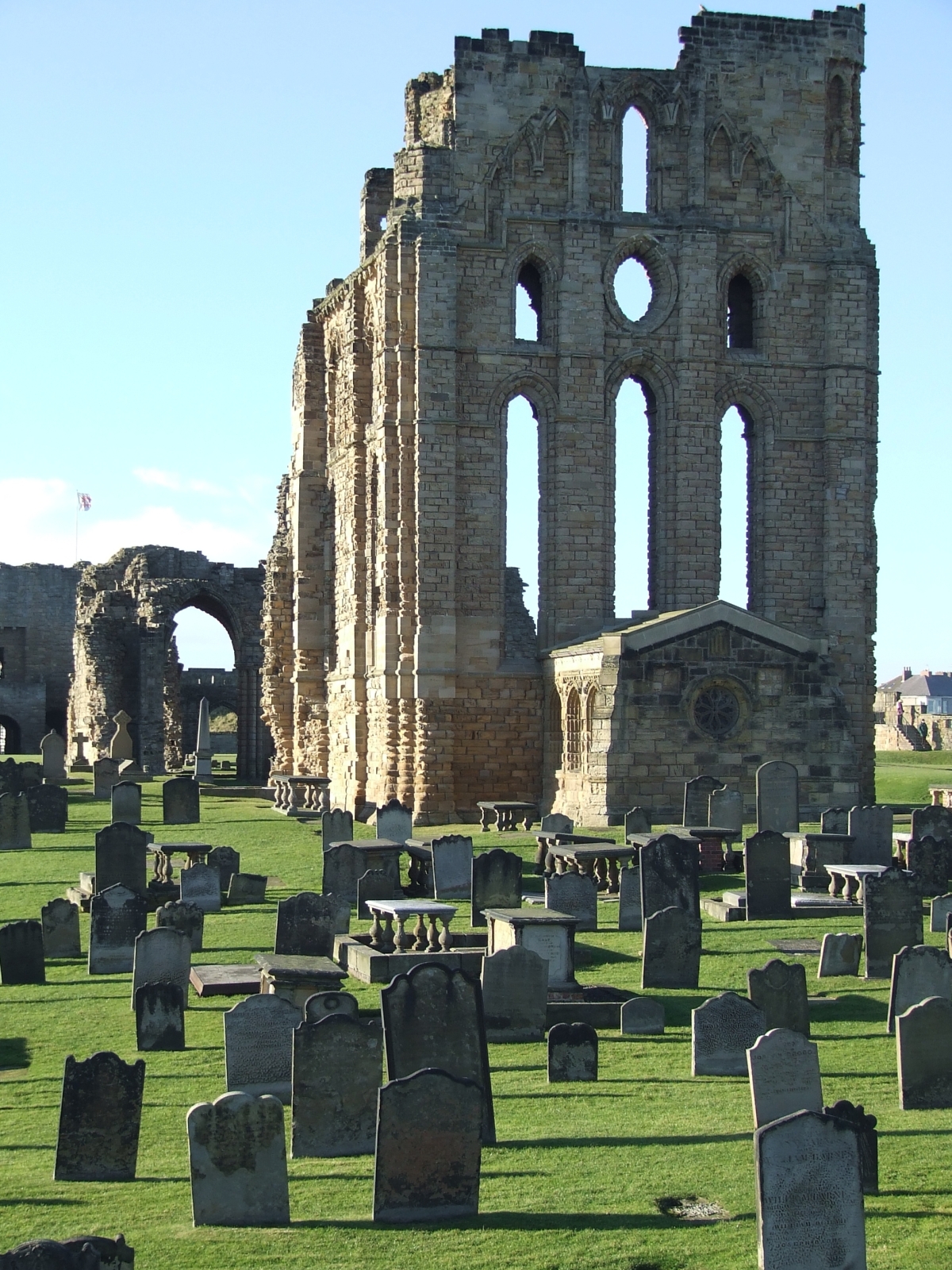
According to both history and legend, three kings are buried somewhere on that headland, including Malcolm III of Scotland. To walk that ground is to remind oneself of the depth of antiquity surrounding it – that people have looked out to sea from that rock since time immemorial, Celt, Saxon, Dane and Norman alike. Thousands of years of continuity lie beneath one’s feet, and it is with a certain reverence one views the salt-eroded stone. Truly, the sea wind does amazing things to building stone, chemically altering it as well as abrading it with gale-driven particles, so what was a fine-built structure seven, eight centuries ago is now a bizarre abstraction, the stone reduced to organic-seeming blobs. There are headstones reduced to this state in the churchyard on the cliffs of Whitby.


The original fortification was a wooden structure built by Duke William’s invaders (though I find it likely there were earlier structures on the site), while the extant ruins are of the extensive rebuilding that occurred in the centuries following. Tynemouth Priory also occupies the headland, protected by the castle from the landward side, and again not much survives. It would have suffered during Henry VIII’s crusade of 1539, known historically as “the dissolution of the monasteries,” when the church was stripped of much of its wealth, power and influence, and so many magnificent ecclesiastical buildings fell rapidly into disrepair and eventually ruin. Only a single internal chamber remains, the “chantry,” complete with stained glass windows, and this was used in later centuries as a magazine to keep gunpowder dry.


The military heritage of the headland is everywhere – not merely the medieval fortress but the guns that guarded the river mouth in much later times. A canon of 1859svintage is preserved in a firing embrasure on the north side, but the real link with past turmoil is the battery of light model 1893 naval guns in their concrete and steel emplacements which look out to sea as a historic exhibit. These guns were manned in the First World War by the Tynemouth Volunteer Artillery, though the closest the German High Seas Fleet came to Tynemouth was Hartlepool, about twenty miles south, in the early morning of December 16th, 1914.


I stood alone on that headland, looking at the autumn afternoon sea as ferries came and went on their routes to Scandinavia, and imagined how it must have been for the gunners on that bitter night, seeing the flashes to the south as Hartlepool took over a thousand German shells. My late grandmother, aged four, was in that town at the time, if I remember my family history aright. That night Whitby was also hit, and its famous abbey was damaged in the process. So in Tynemouth the gunners must have shivered in their greatcoats and peered into the darkness, nerves on edge and strung out for a sighting. Not that their already-antiquated guns would have been of any effect had the German actually shown up, but the defiant gesture would certainly have been made – and perhaps Tynemouth Castle and Priory would have also come off worst against the poorly-directed gunnery of the pre-electronic age.


One other aspect of local lore about the headland must be mentioned, the ghost of the Viking. Actually a Dane, a warrior named Olaf was left for dead after a 9th century raid but was cared for by the monks. In time he took orders and joined them, but many years later during another raid, he saw his brother killed, and died praying for his lost kin. Locals know him as the Black Monk, and his spectre, so the story goes, has haunted that headland for a thousand years, watching the horizon for the longships to return.


English Heritage has an information office and giftshop in the castle, and one can buy a day ticket to wander the headland and view everything from the graveyard of the priory to the monks’ latrine pits, walk the remaining walls of the fortification and wonder where those kings lie. If you have a feel for history, a sense of the gulf of human experience that has flowed by, this is an excellent spot to visit, and you can grab a good meal in the high street opposite the entry of the castle – try the Turk’s Head pub, I can vouch for their fish and chips!


Some useful links for further reading:


Mike Adamson


That's a stone pillar in the mid-ground, not a modern waste bin!


Late afternoon light, as I was leaving -- it would be full dark before I was back down the coast in Roker.


Related Posts Plugin for WordPress, Blogger...