Showing posts with label museum. Show all posts

Tuesday, January 22, 2019

Tropics in the Chill: The Sunderland Winter Gardens


Over many years I travelled from Australia to the UK to attend conferences at the University of Sunderland, and as a passionate photographer I recorded everywhere I went. There are a great many stories to be told from these journeys and I’m delighted to join Meander to the Max to have the chance to tell them, and to present some of the best of my images.

The first place I’d like to touch down is a very impressive attraction in the city of Sunderland. Sunderland, at the mouth of the River Wear on the northeast coast of Britain, is one of the old industrial cities, a major centre of shipbuilding in the 19th and 20th centuries, an exporter of coal and other products in the time of empire. I’ve heard it called a “cold, grey sort of city” and that’s true enough at the time of year I was visiting (the conference was always in November, within weeks of snow typically arriving) but I always found it a very friendly and welcoming place.


Stairs invite one into the green heights.


The town centre, characterised by the Wearmouth Bridge, features a number of old civic institutions, among them Sunderland Museum (Burdon Rd, Sunderland SR1 1PP, UK), behind which you find Mowbray Park and the University. But attached to the Museum is the Winter Gardens, an amazing glass domed conservatory in which tropical trees and plants thrive all year round in controlled conditions.

The Museum has occupied this site since 1879, and the original Winter Gardens were built at that time. They were badly damaged during the Second World War and subsequently demolished, with a new structure in the 1960s occupying the site. However, the present structure was built after lottery-based funding came available in 2001, and the tropical house has been recreated in a modern incarnation that is truly remarkable, both for its sheer size and the variety of tropical species contained.


You can forget you're inside a building!


The exterior view at the head of the article shows the life-size bronze walrus that dominates the banks of the ornamental pool that is thronged with birdlife, including the seagulls seen here.

I visited on my UK foray of 2011, taking in the Museum and Mowbray Park on the same day, but those are worth separate posts at some point. I recall the most impressive aspect being the sense of separation from the outside world – the chilly, grey north-eastern weather was abruptly denied by the humid warmth of the forest dome, and one could wander the elevated walkways among palm and vine, look down into a fish pond, and generally appreciate a feeling more like Australia than England.


Stainless steel and aluminium form a sterile touch of the outside world among a veritable jungle.


A very nice cafĂ© can be found by the entry way, and I recall spending an easy half hour with hot chocolate, contemplating this bubble of the tropics. Not since prehistoric times have such species flourished in this part of the world, and the Victorian skill at glass construction – epitomised by the ill-fated Crystal Palace – brought the life and atmosphere of tropic climes to decidedly temperate latitudes.

For more information, see:


I look forward to further posts, so I hope you’ll meander with me as I explore England and look back on the sights and experiences of getting there and getting back.

Mike Adamson


Kong could appear from among those leaves!

You're a long way up!

It's a memorable view among the steamy airs.


The actual dome and the grey British sky.


Wednesday, April 15, 2015

Riverlands 2014, Part Three: Pelican Point, Broken Cliffs and Morgan

This is where we're headed: the River Murray in South Australia...
The trusty Mitsubishi Magna "Lola" takes a breather between Blanchetown and Morgan,
under a spectacular morning sky that, uh, bodes ill for the weather late this afternoon!
Getting close to the deep-water channels where the riverboats ply...

Dave, the intrepid explorer, under those spectacular skies ... "god rays" and all.
Houseboats moored in idyllic conditions on the Murray River at Pelican Point.
Imagine waking at dawn to the sounds of birds  on the river, in one of those houseboats! One of these days...
Pelican Point ... and here's the pelican to prove it!
A place called "Broken Cliffs" ... for obvious reasons. Picturesque scenery -- quite the photo op --
-- a great opportunity to use your telephoto option --
-- and Broken Cliffs is right off the side of the road there, just a short distance from Morgan.
Welcome to the historic river port of Morgan ... and breakfast is on our minds by now. Urgently!
To get to Morgan, you have to cross the Murray River. A bridge? Don't be silly.
It's much better than that. We do love these drive-on, drive-off cable ferries!


...drive off again, and you can glimpse Morgan itself right at the top of the slope here.
The Landseer building in Morgan is a cultural museum now, but the signage tells all:
back in the golden age of the paddle steamers, A.H. Landseer Ltd. was a logistics company,
working the river and lakes. There's a Landseer building in Milang, too. 
You're kidding ... the Bank of Adelaide was a cottage?! Yep.
Morgan has a gorgeous view of the river, and whaddaya know? Riverboats.
Looks like more people live on the river than on the bank. Many of these will be tourists, like us.
 Breakfast at last! The Morgan Riverview Cafe -- very good bacon and egg rolls ...
though we could have chosen fish-'n-chips or meat pies. For brekkie. Thanks -- we'll take the bacon and eggs!
A stroll after breakfast took us the old wharf and disused railway station... 

A white faced heron was drying off in a riverside tree, after catching his own breakfast.
Back across on the ferry, we hunted down a photo-op spot, to get pretty shots of the river and cliffs...
Then it's back on the road. Uh, dirt track? Did we just run out of road?
You rejoin the bitumen a few kilometers away, under skies that have begun to brood, and
we'll be in Waikerie before lunch!
Exploring places you never visited before is always a lot of run, and this trip took us almost out of the state, in a region known as the Riverlands.

The Murray River is life's blood to South Australia, but it actually rises in the Australian Alps in NSW and Vic; and some of the most spectacular stretches are in fact over the state line. Well, we'll get there one day -- and the best way to do that is on a riverboat cruise out of Renmark. Save all of that for another trip, because there was so much to do on this one.

From Blanchetown (see the previous post) in the early morning we followed the river north to Morgan, where we stopped from breakfast. Rural cafe food can be overwhelming: you can score fish and chips, meat pies, sausage rolls, deep-fried anything, at 7:00am. Luckily, most places also do a very neat line in bacon and eggs, in some form.

Suitably refueled, we took a stroll, discovered a little about the rich history of the area. Then the river heads east and southeast, curving back on itself, and it's impossible to get lost. The road follows the river, and you follow the road.

From Morgan, it's onward into the richest agricultural country either of us has ever seen on any continent ... places like Waikerie, Cadel, Berri, Loxton ... and some surprises: the proverbial "pub in the scrub," and a lock on the river, and the world-famous Banrock Station, and "the Big Ram," and at last, one of the most amazing sunsets we've ever seen, as we headed back up the Southeastern Freeway, just an hour from home.

More in the next segment of this trip!

Monday, December 30, 2013

The South Australian Museum ... Part Two

Destination: the South Australian Museum...
The T-Rex standing vigil on the door --
The Baleen Cafe, with the museum's "little shop" just to the left...
The view from the foyer, across the gardens to North Terrace. Hot out there, cool inside!
An allosaurus skeleton poises, ready to pounce, above the information desk
The other end of the beautiful glass foyer ... let the exhibits begin!
The Polynesian collection is vast and fascination --
-- you could spend an hour on this display alone.
It wouldn't be a museum without an Egyptian room, right? Mummies and all!
The fossil collection is reminiscent of fractal artwork... 
Whale baleen on display down by the Baleen Cafe.
Amazing malachite ... this piece of from Burra, which we visited back in April of 2013.
The bronze in the foyer --
-- and the "Thunder Egg" geode in the geology display, not to mention...
...the crystal that looks like it came right from Mars!
The skeleton of a sea turtle is very old, but not as old as --
-- a perfect fossilized trilobite, one of many species that abounded in our waters.
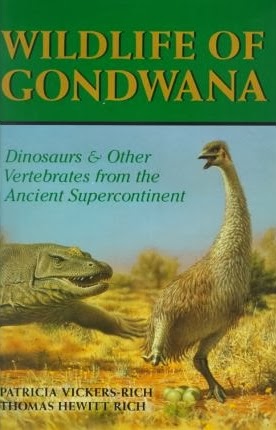
A couple of years ago the museum hosted the Wildlife of Gondwana exhibition --


Thanks for visiting the South Australian museum ... come back soon!
Every time you visit the museum, you wonder where four hours vanished to -- it's so easy to lose track of time. These images were gathered on several visits, most notably the Wildlife of Gondwana display of 2010, for which a massive hardcover book was produced. We indulged in a copy at the "little shop" on the way out. Copies are still circulating -- give Amazon a shot. The display/show was designed by Monash University, and in fact has a permanent page on their site. For a cool sixty grand, in Aussie dollars, you can hire it, complete with three specialist technicians who come out to install it, including setup and takedown. It really was amazing.

And of course, what you see above doesn't even scratch the surface of what's actually in the museum on a permanent basis. One of the most fascinating displays is of the history of Antarctic exploration and settlement, but the light levels there are prohibitively low. Photography is allowed inside the museum, but flash isn't (duh), and with the flash turned off, it's very difficult to get images at all, much less good ones.

(The cameras we use are Fuji, ranged over several generations of development, and it's interesting to see how different cameras handle the challenge of low-light different ways. Most images on this post were captured with the Fuji Finepix HS10, which is now waaay obsolete, of course. The HS50EXR is the current model ... with 16 MPs, 3" LCD, 42x Optical Zoom ... droool!)

Soon enough, you find yourself making your way back to the tram ... rush hour traffic is starting, with the sun angling down and the streets hot, dusty. Or you might have visited the museum in the dead of winter, and you'll be rushing through the rain to get back to the tram stop. Then, a ride back to Glenelg with the early commuters. Might even have learned a thing or two!
Related Posts Plugin for WordPress, Blogger...