Showing posts with label animals. Show all posts

Wednesday, November 29, 2023

Kinchina CP, Murray Bridge ... Thunderfoot!


Kinchina is a CP, or Conservation Park, not far from Murray Bridge -- in fact, it's adjacent to the Mobilong facility. Dave and I went there to spot birds (no joy: barely even heard any, and saw just one ... no photos worth sharing). But instead, we saw something we have NEVER seen before. And although I was thrilled and privileged to see this incredible animal, I actually hope not to see another like him. I'll call him Thunderfoot, because --


When he took a STEP -- not hopping, just stepping forward -- the impact of those immense feet sounded like a horse cantering over soft ground. Thudd!!!! 

We heard him before we saw him. We knew something was out there. I wondered if there were some big horses loose in the park -- a whole bunch of deer jumping at the same time could have made a similar thudddd sound. Then Dave spotted what we thought (ha!) was the proverbial Really Big Roo. I said words along the lines or "Wow, look at the size of him!" I popped a couple of frames ... then noticed the body morphology. It was the female. The doe --

And then Dave spotted the male. The one who made that heavy, dense, soft thuddd every time he took a step. When you weigh about 200 kilos, this is what it's going to sound like -- and this weight estimation is based on observation and cold, hard logic. A horse easily weighs more, but it sounds comparatively loud because all that weight is falling on a small area, the hoof: a horse walks on its middle toe, right? Now, consider an animal which is not called a macropod, or big-foot, for no reason. His feet are immense. To hear that same "shire horse cantering" type of thuddd sound, you'll need an utterly enormous weight spread out over that huge foot.

The size of him ... 

Those are trees, not shrubs, around him. That's a boulder, not a little rock, just left of centre of this frame. Now, look at the foliage on the foreground tree: mark the scale of it ... but this animal is standing at least eight meters, probably closer to ten, behind that foliage!!

At left here, Dave is standing beside one of the mock-up ancestral animals at the Womambi Fossil Centre, back in 2009. It's one of the extinct tree-browsing kangaroos. (Imagine the proverbial Really Big Roo with the face of a koala, which evolution designed to reach up and browse tree foliage.) The critter at Kinchina, whom we're calling Thunderfoot, is waaaay bigger than this extinct browser. 

Think of the biggest male roo you've ever seen at Belair NP, or Onkaparinga Gorge, or wherever, and -- literally double it. 

It was like looking at a shire horse, and when he moved, that's what it sounded like, back among the trees. 

I've never before felt that frisson of "Oh, oh ..." when coming across a roo in the wild. Never saw one that concerned me, much less made the breath shorten and the hair rise on the back of the neck.

Very carefully, I doubled back around to get a line-of-sight on him without trees in the foreground...


There's nothing for perspective in that shot, but we can tell you this much: if he were to stand up straight, his head would be around nine feet off the ground. Up on those toes? Standing in your living room, his head would be right through the ceiling. His shoulders ... it was like looking at a bull --

A bull that has seen you, is looking right at you, and you're in his territory, and his female is only twenty meters away. For all we knew, there could have been a joey (his baby) in the area, which makes any wild animal protective. He was intent on me, likely for good reason. No way in any world would this animal be leery of a puny little human, but where his joey is concerned...

I popped a couple of quick frames, then very carefully turned around. To be safe, you walk at right-angles to a big, wild roo: you don't make eye contact, and you do not move like you're slinking or sneaking. Slinky walking, eye contact and walking directly toward them emulates the stalking characteristics of the only predator evolution ever threw at animals this big. There haven't been wild dingoes in this part of South Australia for many years -- I don't even know if they're even still wild up in the state's north. But the programming of evolution isn't going to change, not in another million years.

So we walked on, and heard Thunderfoot and his enormous missus boom off into the bushland. It was thrilling, a little bit scary -- like almost but not quite blundering into a grizzly bear in bush Alaska. I wouldn't trade the experience for anything, yet at the same time, I hope not to repeat it! I honestly did not know that roos grew this big  -- and yes, I know exactly what the official documentation says! But I also know what Dave and I experienced. We're savvy people, and entirely used to Clydesdale horses, wild bull moose in Kincaid Park, camels ... those taxidermed bears in the big glass cases at Anchorage Airport! We know what we saw. 

And I won't be diving through the bush with quite the abandon that I used to! Radar on, wits about you, and make enough noise that wildlife can hear you coming! Because it's bigger that you are. A lot bigger. And it has eight-inch talons! It's very fortunate indeed that roos, even humongous ones, are such peaceable herbivores: they absolutely will not attack you ... unless you give them a justifiable reason, like startling them by running right into them, which would make any animal come up swinging.

 So -- don't given them a reason!


Thursday, April 4, 2019

Halls Gap ... "Under the Mountain," literally!


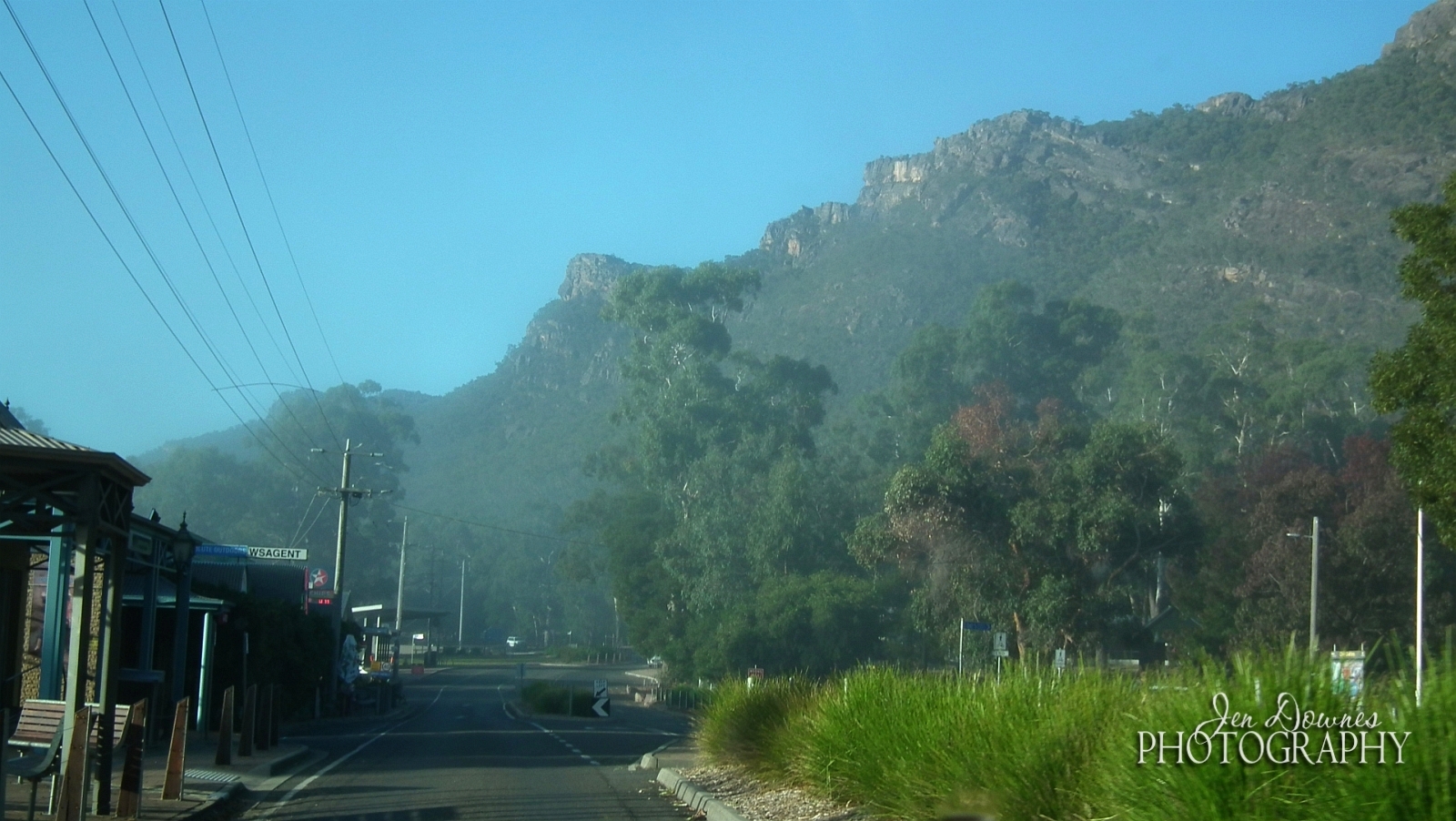
The Village of Halls Gap lies in a pass in the Grampians, quite literally "under the mountain," and often invisible in the morning mist. Here, we see it from Boroka Lookout, in late March 2019...


Driving into the village, you're tremendously aware of being in a mountain pass. The walls rise like ramparts, almost at the bottom of people's back gardens...


From the street -- where you'll find everything you could possibly need, from a newsagent to a supermarket, by way of cafes and ice cream parlor -- just look up under those vines:


The view from the roadside is spectacular!


There's more to Halls Gap than, at first, you assume. Quiet streets angle back from Grampians Road, which is the main thoroughfare, into woodland that's abundant in wildlife, right in the village.


On misty mornings (of which there will be many), Halls Gap drowses like Brigadoon until the sun burns off the fog ...


Up on Boroka Lookout here, it's already sunny (if not quite warm! You're 616 meters high), but if you look off to the left side, you can see the mist that still fills the gap --


...yes, Halls Gap is down there. Did I say Brigadoon?! Magical.

Having arrived in the village, you have about a hundred choices of where to stay. This was ours:


We booked a log cabin at the aptly named Halls Gap Log Cabins ... one word: fantastic! First, there are kangaroos, wallabies, emus, bilbies, in your backyard --


And perhaps just as importantly, the cabins are absolutely luxurious, with a combustion heater, TV/DVD, full size fridge, queen size bed, spa bath ... the works:


You might be in a village in the mountains, but you're certainly not roughing it! (Though there's plenty of that, if you want it: caravanning and camping are very well catered to.)

Now, what about dining out? We did brunch at Harvest, and dinner at Darcy's, which is the restaurant attached to the Comfort Inn...


The food is excellent, and in the evening, long after the sun is down, the grounds around Darcy's, back and front of the Comfort Inn, are thronged with grazing wallabies and kangaroos:


Check out the roo getting a drink at the fountain there! Too cute.

The cultural heart of Halls Gap is Brambuk, where 'Grampians' becomes 'Gariwerd,' and the country's original owners' voice speaks clearly:


We need to set aside a whole afternoon for Brambuk. There's far too much to see and do than you could manage by strolling through. Also, a very nice cafe and the usual gift shop.

On the way out of town...


Lake Bellfield is a man-made lake ... the reservoir serving Halls Gap and the surrounding area. Completed in 1966, just 18 years before Grampians National Park was declared. In Victoria, swimming and sailing are allowed on many of the reservoirs ... wish we did this in SA!

Leaving Halls Gap --


-- the only question is, where are we going today? Hang a right, head for the national park, and keep the cameras handy, because every time you come around a bend in the road, something spectacular happens...


Thursday, April 21, 2016

Destination: Monarto! Lions, giraffes, meerkats ... on safari in South Aus

Lions of the Monarto pride...
A safari in your own backyard! Monarto "Zoo" is certainly not a zoo in any conventional sense of the word. The "enclosures are vast paddocks and the animals enjoy almost as much freedom as they would in the wild, as well as being utterly safe from poachers. Monarto has a small but growing pride of lions, and a couple of young females were close enough to the viewing platform for us to get some terrific pictures.

In fact, there are so many wonderful pictures to share on this post, most of them have been pasted in as thumbnails. If you'd like to see them at full size, just click them: everything is big; we just can't display them large, or this page would be ten yards long!


...at this point the lions meandered away to a patch of shade beyond the reach of cameras, so it was time to hop back on the bus, for a ride to the next part of the park:
Ride the bus around Monarto: very handy ... you buy one ticket at the gate, and then hop on and off the bus at whim,
stopping as long as you like at any one "paddock."
Hunting dogs: faaar away, at the extreme range of telephoto, and on the other side of a fence. Dang. But at least we got pictures... everyone else had left the area! Patience is rewarded.
Monarto's paddocks are connected by walkways to the main bus routes. There's a lot of walking involved, even if you do
hop on the bus the whole time. Wear your walking shoes ... and a hat. Shade is rare, and it can be very hot indeed.

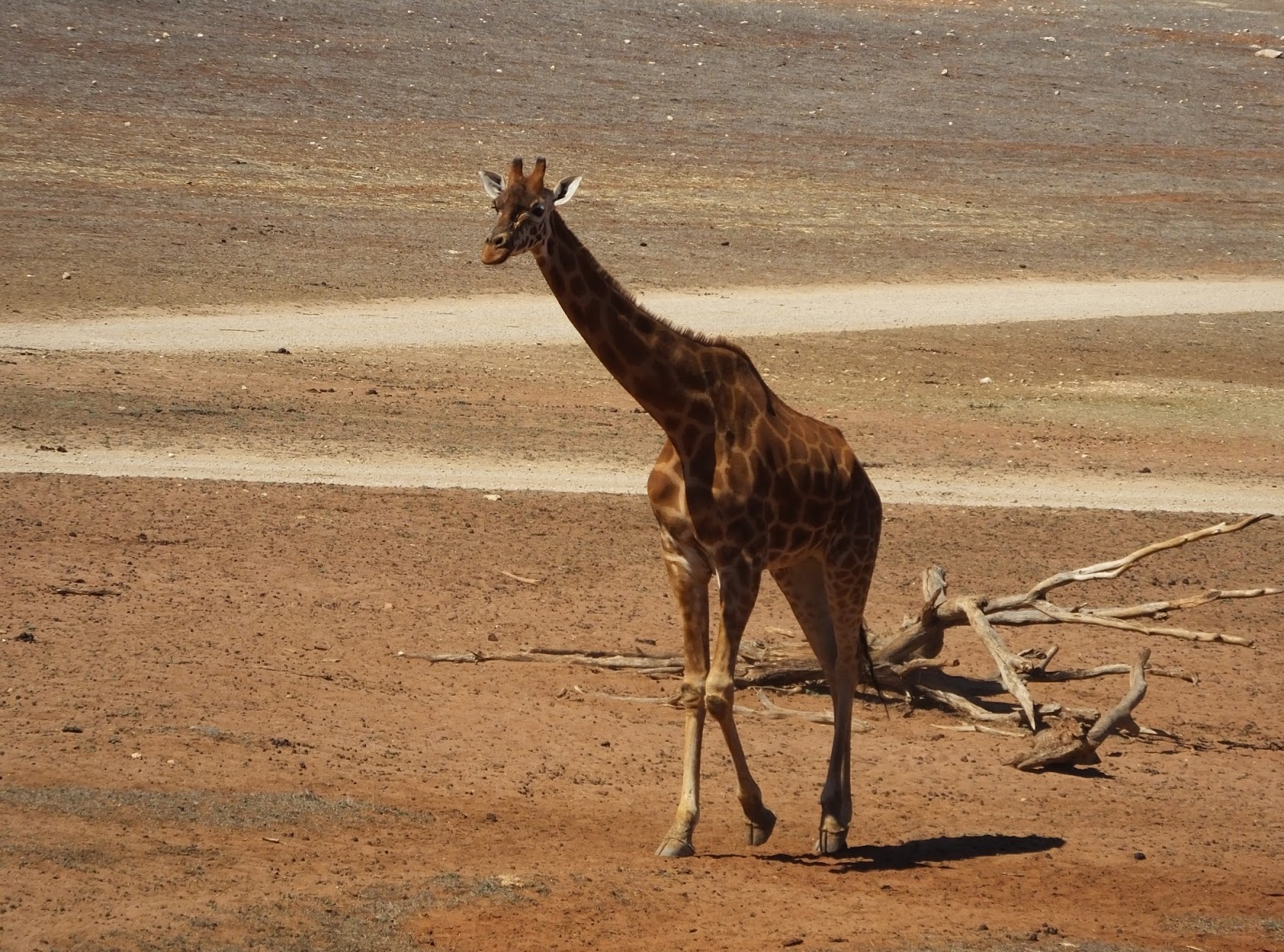
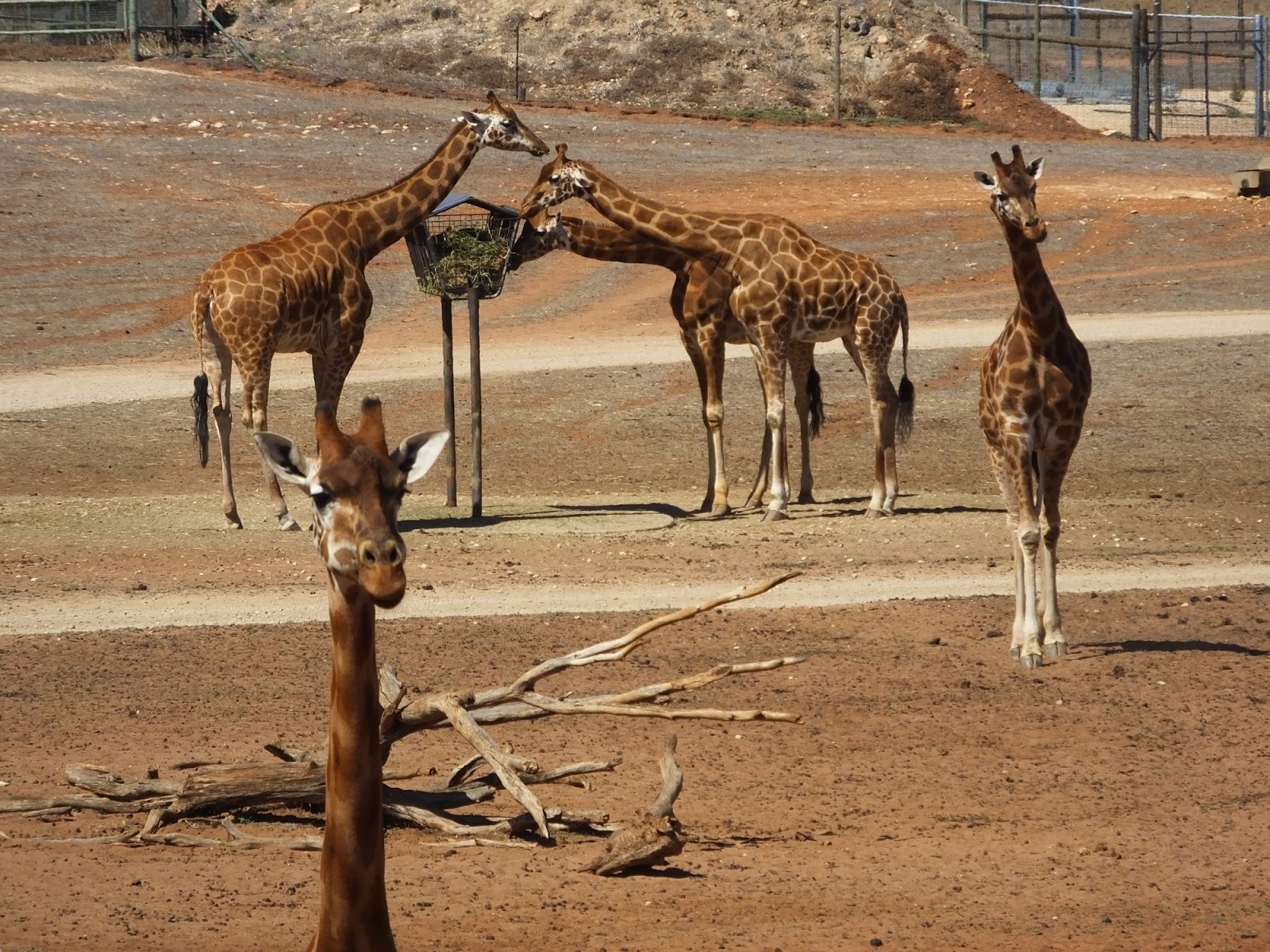
Giraffes at Luncheon...
Giraffes are so pretty! They have the longest eyelashes you ever saw, and the daintiest legs. They're also very, very
shy, and skittish. We happened along just at feeding time, and the busload of eager photographers were
exhorted to be quiet and not make a big fuss.

Giraffes ... with femme fatal eyelashes, and eyeliner. They really are beautiful.


Below: other views in the Giraffe Paddock, which those tall folks share with some bovines whose horns are ... epic. These are eland and kudu. In fact, the bus will swing you through several vast "enclosures" where you really could believe you were on the savannah ... except for the fact those are eucalypts in the background rather than the acacias one would actually expect in Africa...


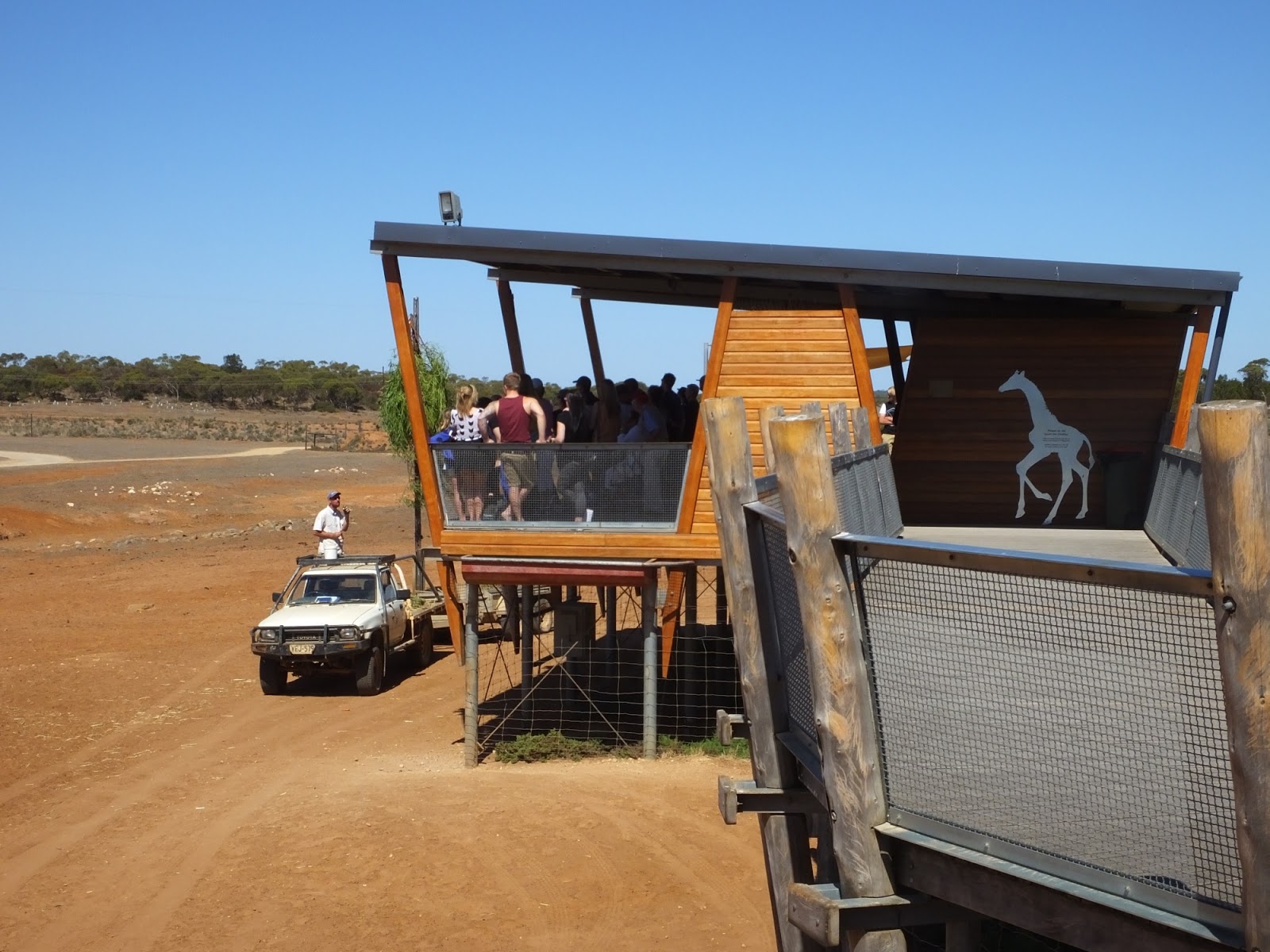
The giraffe viewing platform is -- well, elevated, which affords a great view of Monarto's giraffes. The animals come
right up to the platform, where the specialist will occasionally hand-feed a carrot while giving a layman's lecture on
giraffes in general and these gorgeous animals in particular. 


Now, we'll take the bus through herds of bovines ... the herbivores are separated out from the lions by tall fences and distance, naturally. Stock feed comes in by truck for the animals, since -- as you can see at a glance -- they "eat out" the graze immediately. (What are the lions eating? One almost hesitates to ask, but we could make a few rather unfortunate guesses. What else can you do?)

And in the background, behind the bus, yes: an ostrich, not an emu!


Meerkats on sentry duty ... and at play!
There's only one word you could use to sum up meerkats...
The word is, CUTE!


Back on the road, leaving Monarto and headed for Murray Bridge, Langhorne, Milang, Goolwa ...
Monarto ... covered in one post! The hardest thing about this one was figuring out which pictures not to upload, because there were so many fantastic ones, and then figuring out how to display more than fifty images on one post with some skerrick of coherence! Reiterating -- ALL the images were uploaded at large size, and to see them, just click on the thumbnails.

The park is enormously rewarding though the ticket price is quite high, as you'd expect. Be prepared to do a LOT of walking; do put on your walking shoes and take a hat because you'll be in the sun a great deal and it's almost certainly going to be hot, unless you brave the mud in the middle of winter!

Here's what Wikipedia says of Monarto:

Monarto Zoological Park (also known as the Monarto Zoo) is a 1,500-hectare (3,700-acre) open range zoo located in South Australia administered by the Royal Zoological Society of South  Australia Incorporated (trading as Zoos SA). It is located at Monarto approximately 70 kilometres (43 mi)  from Adelaide's centre.

The zoo features several unique attractions, including a drive-through cheetah habitat, a southern 
white rhinoceros habitat, and Australia's largest giraffe herd. It is also home to South Australia's largest  revegetation project. As of 2015 Monarto zoo has achieved one of the most successful giraffe breeding  programs in Oceania.

We enjoyed it enormously -- would recommend it, and will doubtlessly do it again one day. But as the shadows were lengthening it was time for us to hit the road again. We had a long way to go, and another day in which to do it!

Next time: Murray Bridge, Langhorne and Milang in the morning light...
Related Posts Plugin for WordPress, Blogger...