|
| The Clare Valley Motel, with the sun rising right behind the photographer, and Dave unlocking the car... |
 |
Right outside Room 24. You could tell it would be a hot day...
something in the quality of the light just tells you. |
 |
| The hightstreet, or main street, in Clare itself; and -- |
 |
| The Clare Hotel. Post-colonial architecture and West End on tap to boot. |
 |
| Still on the main street, headed out of Clare, and about to turn left for Polish River Hill and points east. |
 |
| A touch of history in a field at the roadside. A "stump-jump plow," eons old. |
 |
| Vineyards on the way up to the Paulett Winery, and ... |
 |
| One view of Polish River Hill, from the balcony at Paulett. |
 |
| Another view from the Paulett veranda. Ye gods, a bushfire? No, just "burning off." |
 |
| The veranda at Paulett Winery ... how'd you like this view on your back doorstep? |
 |
| And "We're off on the road to Mintaro." Not Morocco. Tune fits, though! |
 |
| Mintaro Heritage Town: blink, and you'll miss it, which would be a pity, because -- |
 |
| ...everything in the town is an eon old, and refurbished, like this warehouse or barn, and -- |
 |
| -- this farmhouse, built in the nineteenth century, and still a home: note the tv aerial. |
 |
The grand gates of Martindale Hall ... they were closed for renovations the day this was taken;
we came back a couple of days later and went inside. Oooooh, boy. Stand by for shivers...
That'll be the post to read in daylight. With company. |
 |
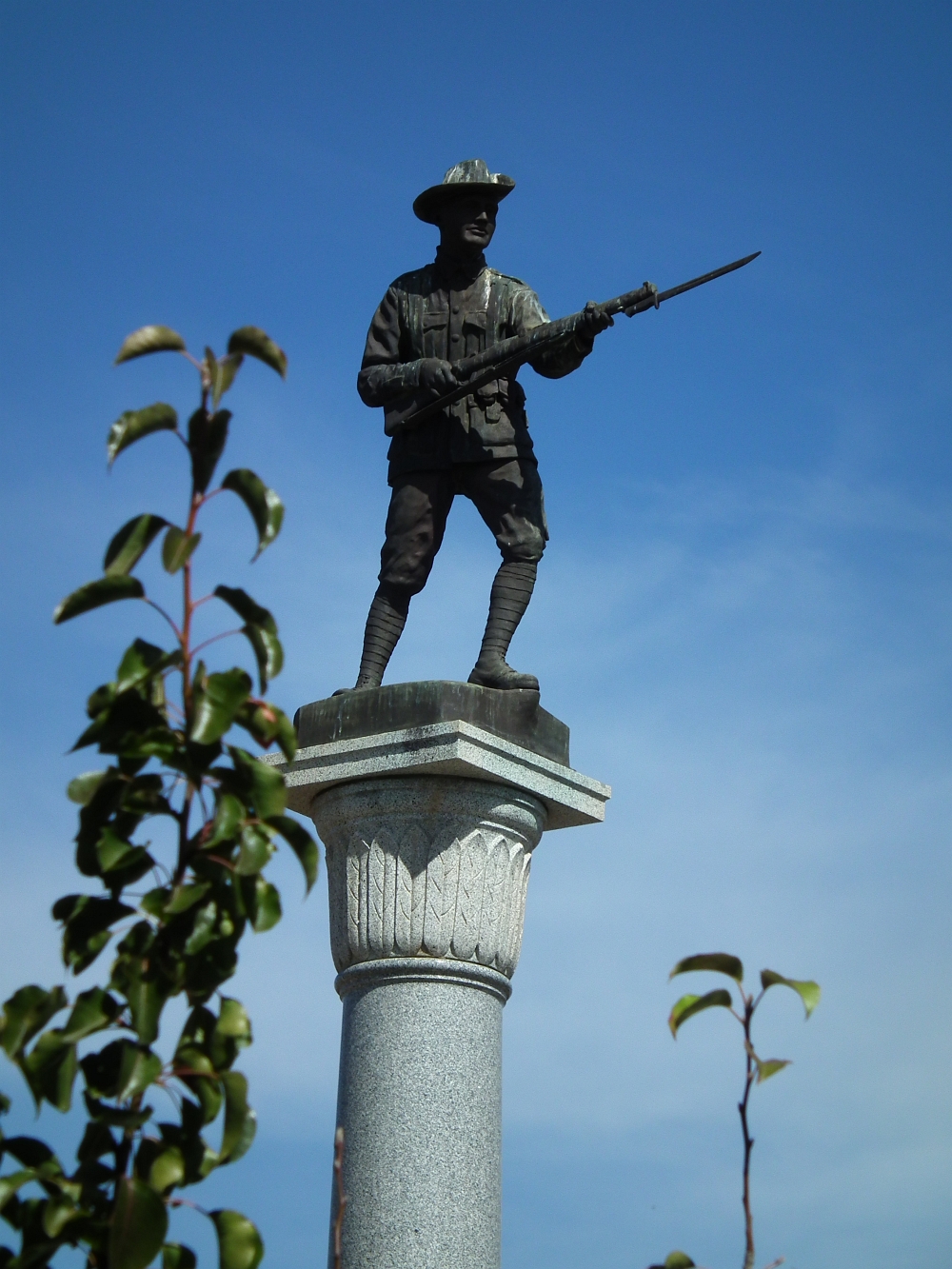
| Burra, South Australia -- the main drag, looking toward the war memorial... |
....
 |
| ...and a zoom shot of the statue atop the war memorial. |
 |
| Burra is a charming town, in fact, with a character all its own... |
 |
Shady spots along the river, where can get out of the sun long enough to
pop open your picnic basket and excavate for lunch. |
 |
A touch of history near the river: original wagon wheels. They're huge. Most probably off one
of the bullock drays that carried copper ore out of Burra to the ports on the gulf. |
 |
Cheek by jowl with all this history ... the wind farms producing much of the power
used in South Australia's "mid-north agricultural" region. |
 |
| Take the hill out of town, see Burra from the overlook -- |
 |
| ...read a potted history of Burra and its satellite towns. |
 |
| It's astonishing how many original buildings still survive ... living history. |
 |
The region is dotted with these chimneys, which were once part of the smelters.
This was copper mining history -- |
 |
Look one way, and you see just the town and dry hills that seem to never end, but --
look the other way, and you'll get the whole picture! |
 |
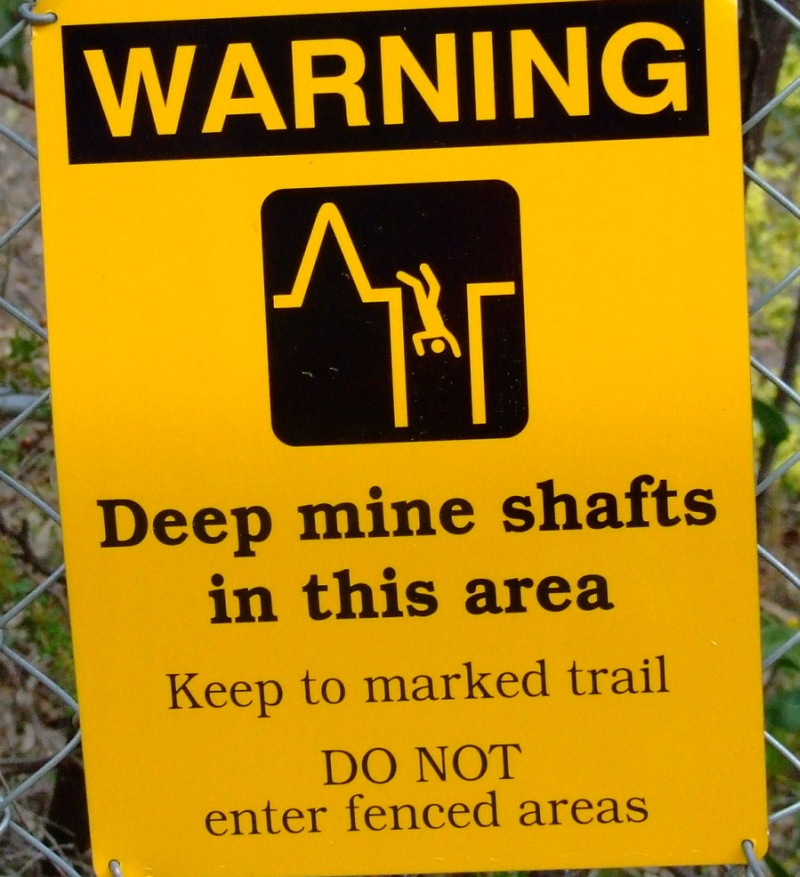
| Here's a potted history, courtesy of the SA Department of Mines and Energy... |
 |
| ...and the mine itself. They were still working this till 1981, but the water is now 50 meters deep... |
 |
| Trying to imagine working here in the colonial era ... the heat and dust and ... more heat. Eep. |
 |
This was the "magazine," or the explosives store. When the mine began, they'd have been
using good ol' fashioned gunpowder, since dynamite had not yet been invented. |
 |
From the mine, the ore went to the nearby smelters. Many chimneys survive ...
from the smelters, the copper went by bullock dray to the ports on the gulf, like
Moonta and Wallaroo. We'll show you those in a later post. |
 |
Take a minute out to see this at full size, and just read it...
There's a mighty historical novel in this somewhere! |
The day was going to be hot, no doubt about it. There's something in the quality of the sunlight, even something about the air, that warns you to slather on the sunblock and don't forget your hat. Lola was quite ready to put rubber to bitumen by about eight o'clock, and we put a picnic in the trunk, guessing we'd be gone till late. First stop: Foodland on main street. Of all the things to overlook when packing, the salt shaker out of your picnic basket is one you'll miss the most!
First stop, out of Clare: the
Paulett Winery, at Polish River Hill, so called for the Polish settlers who opened up the area. There are two kinds of land on which you can grow vines here; one side of the hill, the vines are grown on loam, and the result is s soft "warm" wine; on the other side of the hill, the vines are grown on slate, and the wines are sharper, with a spicy, or "mineral" finish. The ones we tried were the spicy ones ... very, very good indeed. We bought a couple ... still have them, at the time of this writing. Just need an excuse to open them!
The address of the Paulett Winery is "Seven Hills - Mintaro Road," which tells you where we were headed next. Mintaro is a crossroads around which are clustered about a dozen, maybe a dozen and a half, buildings that are not just old ... they're
original. Blink as you blast through, and you
will miss the town, and that would be a shame, because it's a piece of history. Turns out, Mintaro was built to service the "bullockies," the drivers of the bullock dreys that took the copper from Burra to the ports on the gulf. Seemed like a great idea to put a town there, but just 11 years after Mintaro was built, the bullock wagons were rerouted, bypassing the town and leaving Mintato to become something, one images, of a ghost town. Fortunately, slate was discovered nearby, the quarry opened, and suddenly Mintaro was a boomtown in its own right.
Mintaro Slate is famous. The quarry far outlived the mine at Burra that was the very cause of Mintaro existing at all. Neat.
On this day, we didn't actually stop in Mintaro: eveything you see here was shot right out of the car as we headed through, bound for Burra and World's End. We'd wanted to visit
Martindale Hall on this trip out, but it turned out to be closed for renovations on this exact week -- open again at the weekend. Rats. So we rescheduled ourselves around Martindale, and put it on the agenda for Saturday, after checking out of the Clare Valley Motel and having lunch at Mr. Mick's, in Clare itself, ahead of the drive back to Adelaide. Stay tuned for all of that, later. Can we say, "Haunted house?" Ye gods. What's astonishing is that the Hall is open as a B&B right now. Jade changes color at the thought of spending a night there. With the lights out. An hour in the afternoon with the weather changing and the air thick, heavy, with smoke and dust was moooore than enough...
We got into Burra around noon, when the heat and UV were both high ... in fact, the UV must have been close to offscale. You could feel your lips sizzling, and your eyes were dry and sore. It was also very dusty and smoky. Late fall in the mid-north agricultural region is the time of "burning off," and in fact, from the veranda at the Paulett Winery you could see fires burning over the hill. We'd seen these fires on the drive north, on Wednesay, and at first glance we'd wondered about a bushfire. Nope. Turns out, after a crop is in, sheep are first grazed through the big paddocks to eat up anything edible, and then the paddock is burned off before the ash is plowed in. This feeds the land, makes for a better crop next year ... but it puts massive clouds of smoke into the air, and no way can it be good for the ozone layer, the environment, the rate of global warming. You have to wonder about that.
The Burra mine is a huge pit, with fifty meters of water in the bottom. In its day (which ended about thirty years ago) it must have been an anthill of activity and industry, but today Burra and the little towns around it are sleepy, close to dormant. They service the agricultural community, and bring in a number of tourists like ourselves ... but there's a history behind all this that would make a great -- big -- novel. Rather than rattle on, here, about the history and mines, the whole thing has been done in images and captions ... scroll up.
With the mines viewed and photographed, we sought a patch of shade, had a lunch of baked potatoes and hardboiled eggs and avodacoes, and headed out for the World's End Highway, and the Burra Creek Gorge. We'd wanted to do "Burra and World's End" in one post, but the volume of images soon made it obvious -- it's not one post, it's two. So --
tomorrow, World's End and Burra Creek Gorge.