Showing posts with label Murray Bridge. Show all posts

Wednesday, November 29, 2023

Kinchina CP, Murray Bridge ... Thunderfoot!


Kinchina is a CP, or Conservation Park, not far from Murray Bridge -- in fact, it's adjacent to the Mobilong facility. Dave and I went there to spot birds (no joy: barely even heard any, and saw just one ... no photos worth sharing). But instead, we saw something we have NEVER seen before. And although I was thrilled and privileged to see this incredible animal, I actually hope not to see another like him. I'll call him Thunderfoot, because --


When he took a STEP -- not hopping, just stepping forward -- the impact of those immense feet sounded like a horse cantering over soft ground. Thudd!!!! 

We heard him before we saw him. We knew something was out there. I wondered if there were some big horses loose in the park -- a whole bunch of deer jumping at the same time could have made a similar thudddd sound. Then Dave spotted what we thought (ha!) was the proverbial Really Big Roo. I said words along the lines or "Wow, look at the size of him!" I popped a couple of frames ... then noticed the body morphology. It was the female. The doe --

And then Dave spotted the male. The one who made that heavy, dense, soft thuddd every time he took a step. When you weigh about 200 kilos, this is what it's going to sound like -- and this weight estimation is based on observation and cold, hard logic. A horse easily weighs more, but it sounds comparatively loud because all that weight is falling on a small area, the hoof: a horse walks on its middle toe, right? Now, consider an animal which is not called a macropod, or big-foot, for no reason. His feet are immense. To hear that same "shire horse cantering" type of thuddd sound, you'll need an utterly enormous weight spread out over that huge foot.

The size of him ... 

Those are trees, not shrubs, around him. That's a boulder, not a little rock, just left of centre of this frame. Now, look at the foliage on the foreground tree: mark the scale of it ... but this animal is standing at least eight meters, probably closer to ten, behind that foliage!!

At left here, Dave is standing beside one of the mock-up ancestral animals at the Womambi Fossil Centre, back in 2009. It's one of the extinct tree-browsing kangaroos. (Imagine the proverbial Really Big Roo with the face of a koala, which evolution designed to reach up and browse tree foliage.) The critter at Kinchina, whom we're calling Thunderfoot, is waaaay bigger than this extinct browser. 

Think of the biggest male roo you've ever seen at Belair NP, or Onkaparinga Gorge, or wherever, and -- literally double it. 

It was like looking at a shire horse, and when he moved, that's what it sounded like, back among the trees. 

I've never before felt that frisson of "Oh, oh ..." when coming across a roo in the wild. Never saw one that concerned me, much less made the breath shorten and the hair rise on the back of the neck.

Very carefully, I doubled back around to get a line-of-sight on him without trees in the foreground...


There's nothing for perspective in that shot, but we can tell you this much: if he were to stand up straight, his head would be around nine feet off the ground. Up on those toes? Standing in your living room, his head would be right through the ceiling. His shoulders ... it was like looking at a bull --

A bull that has seen you, is looking right at you, and you're in his territory, and his female is only twenty meters away. For all we knew, there could have been a joey (his baby) in the area, which makes any wild animal protective. He was intent on me, likely for good reason. No way in any world would this animal be leery of a puny little human, but where his joey is concerned...

I popped a couple of quick frames, then very carefully turned around. To be safe, you walk at right-angles to a big, wild roo: you don't make eye contact, and you do not move like you're slinking or sneaking. Slinky walking, eye contact and walking directly toward them emulates the stalking characteristics of the only predator evolution ever threw at animals this big. There haven't been wild dingoes in this part of South Australia for many years -- I don't even know if they're even still wild up in the state's north. But the programming of evolution isn't going to change, not in another million years.

So we walked on, and heard Thunderfoot and his enormous missus boom off into the bushland. It was thrilling, a little bit scary -- like almost but not quite blundering into a grizzly bear in bush Alaska. I wouldn't trade the experience for anything, yet at the same time, I hope not to repeat it! I honestly did not know that roos grew this big  -- and yes, I know exactly what the official documentation says! But I also know what Dave and I experienced. We're savvy people, and entirely used to Clydesdale horses, wild bull moose in Kincaid Park, camels ... those taxidermed bears in the big glass cases at Anchorage Airport! We know what we saw. 

And I won't be diving through the bush with quite the abandon that I used to! Radar on, wits about you, and make enough noise that wildlife can hear you coming! Because it's bigger that you are. A lot bigger. And it has eight-inch talons! It's very fortunate indeed that roos, even humongous ones, are such peaceable herbivores: they absolutely will not attack you ... unless you give them a justifiable reason, like startling them by running right into them, which would make any animal come up swinging.

 So -- don't given them a reason!


Saturday, April 23, 2016

Monarto to Murray Bridge, and on to Milang

Gazelles at Monarto Wildlife Park ... probably heading off to a feeding point. It's getting along to mid-late
afternoon, and we're starting to think about afternoon tea ourselves!
A zebra heads determinedly along a guide fence ... tea, anyone?!
Prezwalski's horse: almost extinct in the wild, and thriving at Monarto.
American bison against a backdrop of native Australian trees -- how surreal is this! Cool, though.
American buffalo ... molting in an Australian fall. How do they manage the Aussie summer??
Monarto's white rhino snoozes the afternoon away in his corral...
...from the bus, which makes its way through these vast paddocks filled with antelope, giraffes, ostrich...
and if you keep a sharp eye out you'll see kangaroos in the distance!
Leaving Monarto, you exit via the gallery and store, which has touch-friendly exhibits...

And we're off on the road to Murray Bridge, hoping for afternoon tea.
Murray Bridge -- Mobilong Precinct, above the wharf...
Parklands along the river ... where we stopped for a picnic, since no place in town was open for a decent meal!
Bizarre as it sounds, every restaurant and pub stops serving at 2:00pm and doesn't reopen till 6:00.
Galahs (often known overseas as rose-breasted cockatoos) cavorting in the tree over our picnic spot...

...powerboats and water-skiers zipped up and down on the river, and a family of noisy miners cadged for crumbs.

The afternoon sun was lowering as we headed for Milang, where we were booked in at our usual --
the Milang Lakes Motel, our favorite place to stay on Lake Alexandrina.
It's a picturesque drive, especially in good weather. Often, the skies darken as you approach Milang, but
this time we were lucky ... blue skies all the way.

A strong wing raises whitecaps on Lake Alexandrina, on the way into town...
An Australian magpie stands beak-to-the-wind under a racing windlass.
Lake Alexandrina -- the lakeshore. Actually, a shot borrowed from another day, as you can tell from the
calm lake surface and the lovely sky. Confession: after Monarto, I was dead tired and ready for a rest at the motel! 
Milang: Paddle Steamer Drive, seen across the wetlands -- again, borrowed from another day.
And Milang: the bird sanctuary. Should be called a FROG sanctuary! Dang, those guys are loud at night.
The main thought in our minds as we left the Monarto Wildlife Park was FOOD. We'd intended to head to Murray Bridge for something like a very late lunch or very early dinner, but plans were upturned by the fact that every restaurant or pub in town was no longer serving. They close the kitchen at 2:00pm and don't reopen till 6:00, so we were out of luck, unless we wanted fast food, which we didn't.

The solution was a somewhat on-the-fly picnic, in the parklands by the river. Wouldn't you know it? Usually we go out loaded (and bring back 90% of the food). This time we'd intended to go "cafe to cafe," so we hadn't over-packed. But enough was in the cooler to put something together, and we didn't exactly starve.

Then, on to Milang as a strong wind began to crank. The lake was energetic with whitecaps, and we guessed it would be cold later. But what got our hopes up was the clear blue sky. For the first time in many years, you'd see stars tonight. And Milang is so far from any town that the skies there are DARK ... we were longing to see the Milky Way, and were not disappointed.

We put on as many layers as we could and went out at about 10:30pm. Aha! The sky was blazing. You can walk out of town in 90 seconds, and we did. The whole galaxy arched overhead like something out of a movie. Gorgeous! But there was no way to photograph it ... not with "compact" cameras. One of these days we'll go back with a full-on digital SLR and see what can be done.

Next: the lake in the morning light, waterbirds galore, and off to Wellington for breakfast.

Saturday, April 18, 2015

Riverlands 2014, Part Six: wine by the truckload, the world's biggest sheep, and one amazing sunset

Loxton, on South Australia's Murray River, is a wine region producing an amazing volumes as well as
some really wonderful wines... 
Dave checks out the visitor information. As the sign says, "Welcome to Loxton" --!
Everywhere you look, it's tanks of wine ... and watch out for trucks crossing!
Wineries also frequently offer restaurants, cafes and accommodation ... makes it just too easy.
Now, if we could only remember which this one is! Pretty, at any rate.
But the time really had come to turn for home, point the Mitsubishi Magna called Lola toward Adelaide
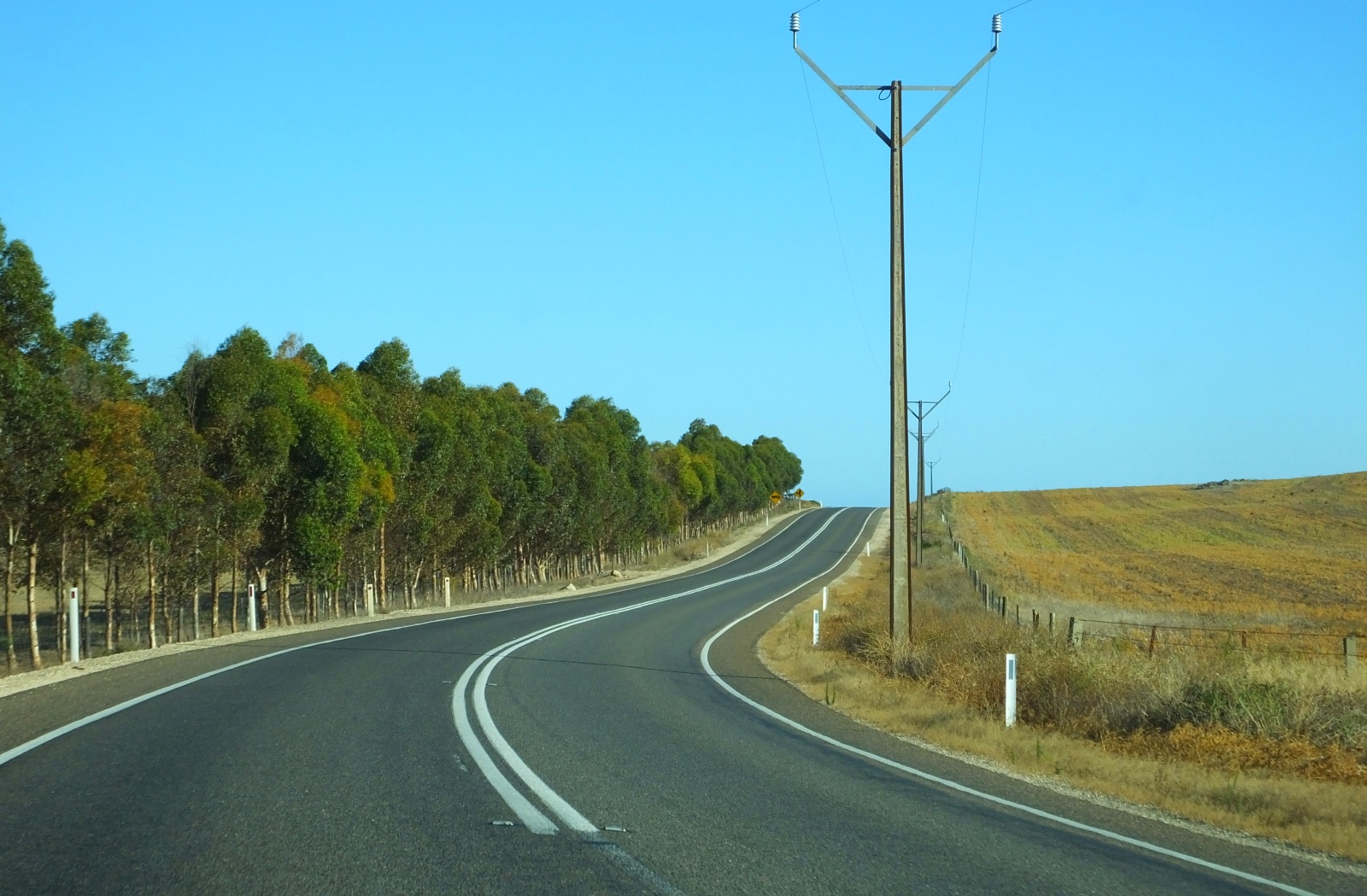
and put the foot down. Heading west from Loxton on the Karoonda Highway, you run into wheat country...
...and the road is a rollercoaster. It was laid down on ancient dunes -- this whole area was once (in geological terms)
the bottom of the sea, and later a desert like the Sahara. The road shows that wave-pattern of dunes...
...as it takes you to (!) Karoonda, on its way from Berri to Murray Bridge. Now, those are grain silos.
Karoonda has quite a history -- perfectly readable here, if you view this image at large size --
-- and also, Karoonda boasts probably the biggest sheep in the world ... concrete, of course! He's HUGE --
known as "the Big Ram" for obvious reasons. It's a tribute to the Merino sheep which made this region prosperous.


Wall art depicts something of Karoonda's past -- neat. (Actually, this graces the west wall of
the public facilities! Neat bathrooms, too ... and halfway from Loxton to Murray bridge, very welcome!)
One of the enormous windlass sails -- these devices played a major part in opening up this country.
As the sign there says, "No wind, no water, no life." Very, very true.
Main street Karoonda ... and at this time on a Sunday evening, almost everything is closed. The pub's open...
Back on the road, we're headed almost due west into the the rapidly-lowering sun...
A beautiful evening, maybe half an hour east of Murray Bridge ...
shot from the side window, at 100kph, hence the movement-blur in the foreground.
Back in Murray Bridge at last, as evening begins to settle down over the hills...
Tail lights gleam in the twilight on the Southeastern Freeway. Headed for home: looks like it'll be a lovely sunset.
Sunset -- perfect conditions! Grab the camera. All these images were captured (by Jade ... Dave was
driving). We didn't even have to pull over. Check out those "god rays."


It's amazing what you can do in two days, if you make an early start and get home late. Looking back over this series of posts, we're astonished ... we packed in a lot. This last post covers just the final few hours as we finally turned for home -- in Loxton. We put the trusty Mitsubishi Magna on the Karoonda Highway to Murray Bridge, through the region known as "the Murray Mallee," and settled in for the long haul.

Halfway back to Murray Bridge you can take a welcome break in the rural town of Karoonda, which is not-quite-world-famous, but a most pleasant community ... with arguably the biggest concrete sheep in the world. "The Big Ram" is a masterpiece statue done as a tribute to the Merino sheep that made this region prosperous in the early 1950s. If you're interested, view the info panel, above, at full-size: it's perfectly readable. (Traveling around, one can be inundated with these pages of history, and Jade usually photographs them to read later. Sometimes there's the makings of a major novel in them -- like the story of the mines in Burra.)

The shadows were long and it was actually getting quite chilly as we left Karoonda with far to go. We knew we'd be getting home after dark, but there was one more treat in store: a thoroughly spectacular sunset, which was photographed from the road at 110kph -- Jade with the camera, Dave driving, obviously. Not too long after the last shot was captured, we pulled into our driveway, home again, home again, too tired to do the jigging part.

Apologies to all that it's taken so long to get these posts up. It's been an "interesting" year. These last episodes are being uploaded after the 2015 road trip -- in fact, as soon as the quick-list for this one is done, Jade will be starting on the next: lions and lakes, bison and barrages, fall colors and fur seals, and the place where photography meets art when the sun rises over Milang. It was a lot of fun, about one month ago at the time of this writing.
Related Posts Plugin for WordPress, Blogger...