Showing posts with label trees. Show all posts

Thursday, April 28, 2016

Rusticana Wines and on to Goolwa -- seals, black swans and pelicans on the barrages

Rusticana Wines takes as its icon this ancient tree remnant which stands
preserved in their coutryard.
Rusticana Wines, sleepy and fragrant on a warm morning at Langhorne Creek
Newmans and Rusticana are two sides of the same company...

(All images are uploaded at large size -- click on them to pull them up BIG. Duh.)

The view from the cafe deck favors their fields and, beyond, the vineyards. What a glorious morning.
Access to the cafe and shop is up  ramp surrounded by tropical plants. Lovely!

Bees working hard in the lavender in the cottage garden out front.
...and we're off on the road to Goolwa in the early afternoon.
Goolwa: the main street, lined with fantastic coffee shops and specialty stores...
The historic Corio Hotel, established 1858, as you head out of town.
Houseboats moored on the riverbank, on the way down to the barrages and the Coorong...
A hot, bright afternoon right beside the Goolwa Barrages, Look to your right, and  --
Goolwa's signature, the Barrages. ..

...and yes, the public can walk out to the mid-point, right in the middle of the river. We did. It was hot!
The signboard in the water: the Coorong National Park begins right here, on the ocean side of the barrages
Black swans, cruising on the ocean side of the lock gates at Goolwa.


So surprising to see fur seals at Goolwa at this time of year, and especially to see them sun-baking ... fur coats and a healthy layer of blubber, in this sun! Looks are not deceiving; the day was a scorcher, especially when you didn't have a patch of shade, and even worse when the breeze dropped away.

We'd expected a stiff wind out in mid-water but at least when we were walking out there, the air was still and sizzling. The fur seals seemed to be soaking up the heat. They must be part feline.

Fur seal, basking in the sun on the lock gates at Goolwa, South Australia


This was also a great day for "birding" on the river because the waterbirds abounded, and were also close at hand as you strolled out to mid-water across the barrages.

Left: black swans, which were out by the fleet; below left: a silver gull, common in any part of Australia. Below right: a pelican -- one of scores that were fishing along the Goolwa Barrages, close enough to reach out and touch. Paradise for bird photographers and obviously not to bad for the waterbirds that thrive here.


A "trailer sailer" heads into the Coorong National Park for a day sail...
...alas, low water at the Goolwa Bid Hide, so it was lucky we'd had good "birding on the barrages...


Rusticana Wines -- aka Newmans, the horseradish farm at Langhorne Creek -- is a destination in itself. They stock gourmet foods from local chefs, such as (!) crocodile pate, and emu liver pate, home-made jams, dukkah from local almonds, and of course the full range of their own products, including wines to die for. The most intelligent thing I can do here is send you right to their website for information!

The Langhorne Creek region is gorgeous, and on the of the qualities they ought to be able to bottle and sell is the sheer peace and quiet. You have to be there to appreciate it. Open the car door, stop and listen before you even get out. You can't buy serenity, but this region dishes it up for free, and come back for seconds if you like. (Also, see this post, and this one, for other visits to Langhorne, and to Bleasdale Wines, just up the road from Rusticana.)

From Rusticana, it was on to Goolwa, and I (Jade) was actually wondering about stopping by the Corio Hotel for coffee. Always wanted to drop in there, and if you've seen their menu, you know why. Check out their website too!

But we decided to press on for the Barrages and the Bird Hide, and do the cafe thing another time (of course a year's gone by, and we still haven't done it). Barrages? What the heck is it all about? The story is here: http://www.murrayriver.com.au/about-the-murray/barrages/ ... and it's all about keeping seawater out of the Murray River. Orginally, the river mouth was closed off, the sea didn't get in. Then it was opened up for shipping, and (what a shock), a freshwater river turned brackish or downright salt, for about fifty miles upstream. Species died off -- it might have been good for business, but it was a natural disaster. Something had to be done, so ... lock gates, barrages, and a lot of work invested in encouraging reed beds to build a proper shoreline.

After the Bird Hide -- where the water was low and the birds much too far away to permit good pictures, we headed north with only one stop: a picnic at Mount Compass. Pictures there were too thin to be worth taking up page space here, especially as we'll be covering Mount Compass in the next trip. So --

Next up: Fall Colors and Crashing Surf, 2016. Coming soon.

Tuesday, June 30, 2015

Dawn at Milang, Breakfast at Clayton Bay, English 'dry stone walls' at Callington, then -- lions and zebras and bison, oh my!

Dawn rises over the wetlands at Milang, South Australia...
...and when we're staying over in Milang the day begins with a photo assignment --
You get up when the first flush of dawn colors appears in the sky, and...
...walk right across the empty main road outside the Milang Lakes Motel...
...and there's the wetlands, and the rising sun.
On this trip the sky was clear, which doesn't make for a brilliant dawn, so --
-- the challenge was to "get creative" with the shots, and... 
...make the most of everything we had to work with. In the end we wound up with so many good shots --
-- the hardest thing was paring them down to a scant handful to upload here!
The weltlands were alive with birds that morning -- 
-- and not one of them came close enough to photograph! So we said  "nuts" and --
-- went right back over to Clayton Bay, pronto, on another assignment: breakfast!
Sails at Clayton Bay is a marvelous cafe-restaurant, and
-- they're situated right there on the waterfront...
--serving the best breakfast you can imagine. This hit the spot. Yum!
Clayton Bay: "you are here." You can actually read the history on the board here, seen at full size.
Looks like a great day to be out on the water. Boats were launching e very few minutes --
-- from the boatramp right alongside the jetty, while...
...pelicans fished for their own breakfast along the riverbank.
But we have a date with lions and zebras, so it's already time to get out of Dodge!
Halfway over to Monarto, we stopped on Callington Road to capture a photogenic landscape. 
The Callington area is a picturebook landscape. It must be lovely in winter, when it's green. Must come back!
Callington would very likely have been settled originally by folks from the UK, because --
check out their "dry stone walls." These are commonplace ... in England's north-east, that is.
Art meets nature. Eucalypt trees shed their bank, not their leaves --
and when they do, sometimes you get an effect like abstract painting. Pretty!
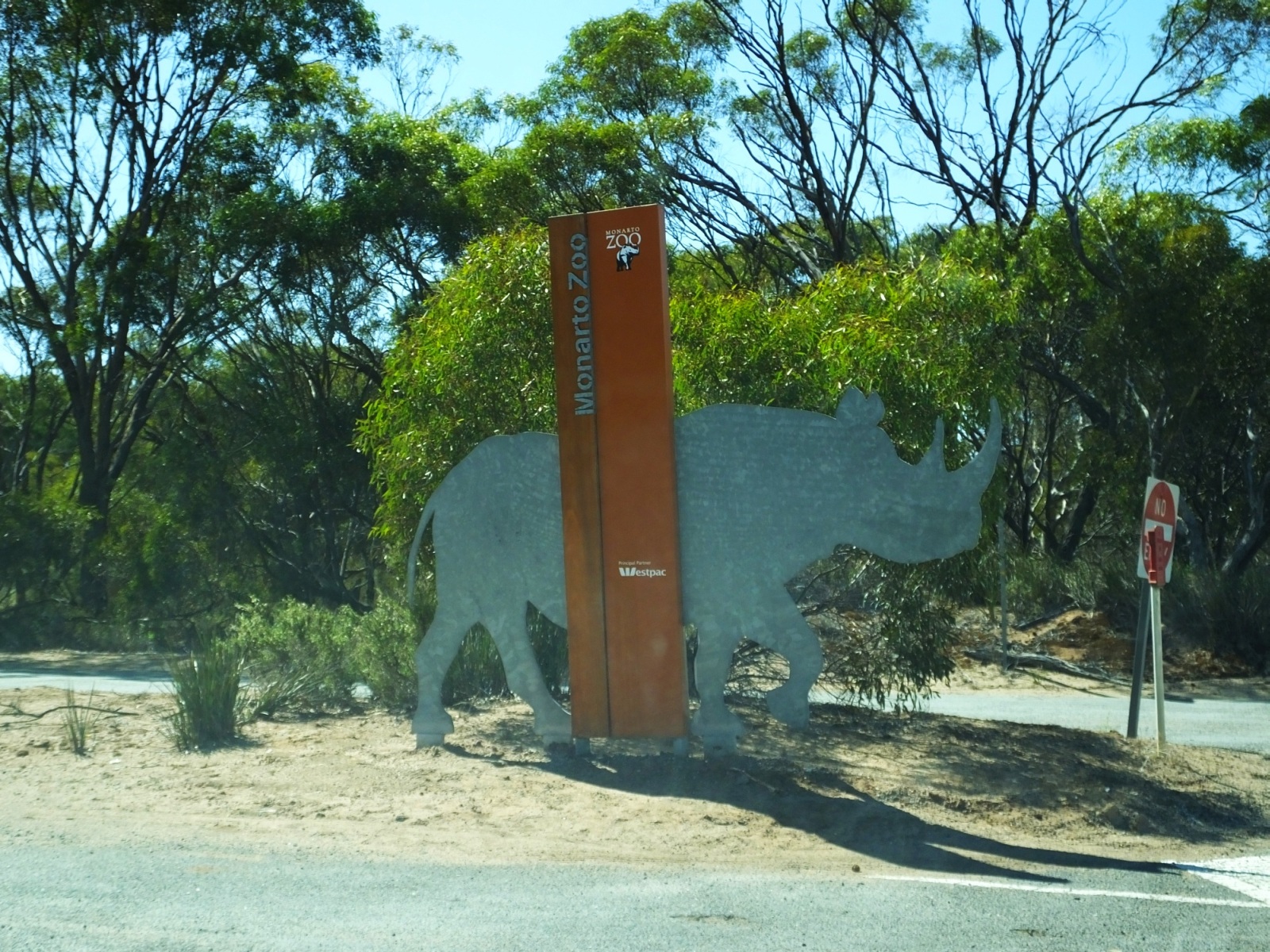
At last -- welcome to Monaro Wildlife Park ... not a 'zoo' as we generally think of them.
Drive right up to the gates and inside. Buy tickets at the kiosk to the right there.
It's actually quite expensive; but then again, it must cost a fortune to run this place. So...
Walking up from the huge "parking pasture" you enter the wildlife park itself right here.
The way in is through the shop. Yep, we'll be stopping there on the way out.
Check out the giraffe skeleton. Wow. There's also a lot more skeletons: next post!
Monarto is home not only to African wildlife, but to endangered species from other continents.
These are Przewalski's horses, and here's what Wikipedia says of them: "Dzungarian horse is a rare and
endangered subspecies of wild horse native to the steppes of central Asia."
And the good news is, they thrive -- and breed! -- at Monarto in South Australia.
Likewise, America bison thrive here -- though they must wonder what happened to the grass.
Seriously, Monarto is a series of massive paddocks in which grazing animals run almost totally free,
and the fact is, they graze simply out the land. Now...
... if Monarto were four times the size, staff could afford to move the stock from one paddock to another,
rotating herds around so the recently-grazed paddock could lie fallow and recover. Alas,
 there's no such luxury, so these animals may run free, but they're fed fro the back of a truck.
The zebras thrive at Monarto, and breed readily in this environment.
And Monarto contributes to the world-wide breeding program which is right now
rescuing the white rhino, bringing it back from the thin edge of extinction.
Grant's gazelles run free ... and the dead giveaway that these are in Australia is
hopping along the fence at upper left! Yep -- kangaroos also abound in these paddocks.
Can't see him clearly? Check out this picture at large size!
Then, it's on to the lion enclosure...
Lions! This is what you wanted to see, right?
We have some great pictures, which we'll be uploading in the next post!

It's been ten years since we last visited Monarto, and we were surprised by the changes. It's much more developed than we recall, and one of the best changes is that they now have a very excellent shuttle bus "service" running round and around inside the park. The bus stops at various points adjacent to the viewing areas for giraffes or lions or whatever, and you can get on and off said bus as often as you like, so you could spend as long as you wanted in a certain place.

The park is 2,500 acres, which sounds like a lot, but if Monarto has one problem it's that it's about 25% as big as it really needed to be, if it were going to remain lush and green. True, it'll be greener in wintertime, but herds of antelope, bison and so on will graze out the paddocks. In the end, the stock will be "fed off the back of a truck." (Which, yes, is also true of local domestic animals -- cattle, sheep, horses, alpacas. Even camels, if you're sharp-eyed.)

It's very good to see species which are endangered in other lands doing well here. One can hope that in future the conditions may be right for returning the great-great-grand-offspring of these creatures to the wild.

The sun shone, we hopped off the bus here and there, and we came home with so many terrific photos, it was a major challenge to pare them down to a comparative handful for blogging. We're also going to cover Monarto in at least two posts, so --

Next time: lions, giraffes and a lot more!
Related Posts Plugin for WordPress, Blogger...