Showing posts with label wildlife. Show all posts

Wednesday, November 29, 2023

Kinchina CP, Murray Bridge ... Thunderfoot!


Kinchina is a CP, or Conservation Park, not far from Murray Bridge -- in fact, it's adjacent to the Mobilong facility. Dave and I went there to spot birds (no joy: barely even heard any, and saw just one ... no photos worth sharing). But instead, we saw something we have NEVER seen before. And although I was thrilled and privileged to see this incredible animal, I actually hope not to see another like him. I'll call him Thunderfoot, because --


When he took a STEP -- not hopping, just stepping forward -- the impact of those immense feet sounded like a horse cantering over soft ground. Thudd!!!! 

We heard him before we saw him. We knew something was out there. I wondered if there were some big horses loose in the park -- a whole bunch of deer jumping at the same time could have made a similar thudddd sound. Then Dave spotted what we thought (ha!) was the proverbial Really Big Roo. I said words along the lines or "Wow, look at the size of him!" I popped a couple of frames ... then noticed the body morphology. It was the female. The doe --

And then Dave spotted the male. The one who made that heavy, dense, soft thuddd every time he took a step. When you weigh about 200 kilos, this is what it's going to sound like -- and this weight estimation is based on observation and cold, hard logic. A horse easily weighs more, but it sounds comparatively loud because all that weight is falling on a small area, the hoof: a horse walks on its middle toe, right? Now, consider an animal which is not called a macropod, or big-foot, for no reason. His feet are immense. To hear that same "shire horse cantering" type of thuddd sound, you'll need an utterly enormous weight spread out over that huge foot.

The size of him ... 

Those are trees, not shrubs, around him. That's a boulder, not a little rock, just left of centre of this frame. Now, look at the foliage on the foreground tree: mark the scale of it ... but this animal is standing at least eight meters, probably closer to ten, behind that foliage!!

At left here, Dave is standing beside one of the mock-up ancestral animals at the Womambi Fossil Centre, back in 2009. It's one of the extinct tree-browsing kangaroos. (Imagine the proverbial Really Big Roo with the face of a koala, which evolution designed to reach up and browse tree foliage.) The critter at Kinchina, whom we're calling Thunderfoot, is waaaay bigger than this extinct browser. 

Think of the biggest male roo you've ever seen at Belair NP, or Onkaparinga Gorge, or wherever, and -- literally double it. 

It was like looking at a shire horse, and when he moved, that's what it sounded like, back among the trees. 

I've never before felt that frisson of "Oh, oh ..." when coming across a roo in the wild. Never saw one that concerned me, much less made the breath shorten and the hair rise on the back of the neck.

Very carefully, I doubled back around to get a line-of-sight on him without trees in the foreground...


There's nothing for perspective in that shot, but we can tell you this much: if he were to stand up straight, his head would be around nine feet off the ground. Up on those toes? Standing in your living room, his head would be right through the ceiling. His shoulders ... it was like looking at a bull --

A bull that has seen you, is looking right at you, and you're in his territory, and his female is only twenty meters away. For all we knew, there could have been a joey (his baby) in the area, which makes any wild animal protective. He was intent on me, likely for good reason. No way in any world would this animal be leery of a puny little human, but where his joey is concerned...

I popped a couple of quick frames, then very carefully turned around. To be safe, you walk at right-angles to a big, wild roo: you don't make eye contact, and you do not move like you're slinking or sneaking. Slinky walking, eye contact and walking directly toward them emulates the stalking characteristics of the only predator evolution ever threw at animals this big. There haven't been wild dingoes in this part of South Australia for many years -- I don't even know if they're even still wild up in the state's north. But the programming of evolution isn't going to change, not in another million years.

So we walked on, and heard Thunderfoot and his enormous missus boom off into the bushland. It was thrilling, a little bit scary -- like almost but not quite blundering into a grizzly bear in bush Alaska. I wouldn't trade the experience for anything, yet at the same time, I hope not to repeat it! I honestly did not know that roos grew this big  -- and yes, I know exactly what the official documentation says! But I also know what Dave and I experienced. We're savvy people, and entirely used to Clydesdale horses, wild bull moose in Kincaid Park, camels ... those taxidermed bears in the big glass cases at Anchorage Airport! We know what we saw. 

And I won't be diving through the bush with quite the abandon that I used to! Radar on, wits about you, and make enough noise that wildlife can hear you coming! Because it's bigger that you are. A lot bigger. And it has eight-inch talons! It's very fortunate indeed that roos, even humongous ones, are such peaceable herbivores: they absolutely will not attack you ... unless you give them a justifiable reason, like startling them by running right into them, which would make any animal come up swinging.

 So -- don't given them a reason!


Thursday, May 5, 2016

Jupiter Creek -- a glimpse of Gold Rush South Australia

Jupiter Creek -- the iconic Beatrice chimney, built in 1869
Welcome to Jupiter Creek -- the trail head. Note the green: we usually do this hike in spring!
The Millennium Possum -- aka the Mitsubishi Express -- waits in the car park...
...and who else should be there in the parking lot, but a bearded dragon! These guys are about a foot long, and shy.
Take a moment before you hit the trail, and read the  information board. The gold rush came to South Australia in the 1850s and 1860s, and the drama was on, full-throttle. Today, it's a haunted, haunting place...
The Jupiter Creek hike is fairly easy, and takes you through up to three kilometers (about two miles) of woodland...

...and the trail takes you to sites like the New Phoenix shaft, which you can actually get into. And we did...
A flash shot of the deep interior of the New Phoenix mine shaft. It's cool, deep underground...
Follow the New Phoenix shaft right through the hill, and you come to a barred gate in a shaft of daylight. 
From the top of the New Phoenix shaft, a ladder goes down into the pit -- and you can climb down:
Dave, being Dave, did just that. Kinda "Spellunking" at Jupiter Creek. 
The trail linking the many mines is well marked. Just follow the arrows, and --
You find yourself approaching many different operations, such as the Beatrice Mine, whose chimney is...
well, it's like something out of The Lord of the Rings. Echoes of dwarven folktales, and Moria... 
The Beatrice Chimney, 1869, Jupiter Creek, South Australia.
Take a minute to read a little of the history of the Beatrice Mine
This was, as Aussies say, "hard yakka." Hard work -- and not for humans alone:
One can only speculate about the life of a draught horse in this era, anywhere in the world.
Nor was Jupiter Creek the only goldfield in the state. Driving the Adelaide Hills and Fleurieu Peninsula
today, it's hard to imagine such tranquil landscapes resounding the the ruckus of a gold rush. Dang.
Many claims were made and worked at Jupiter Creek. You get actually get into one or two, but --
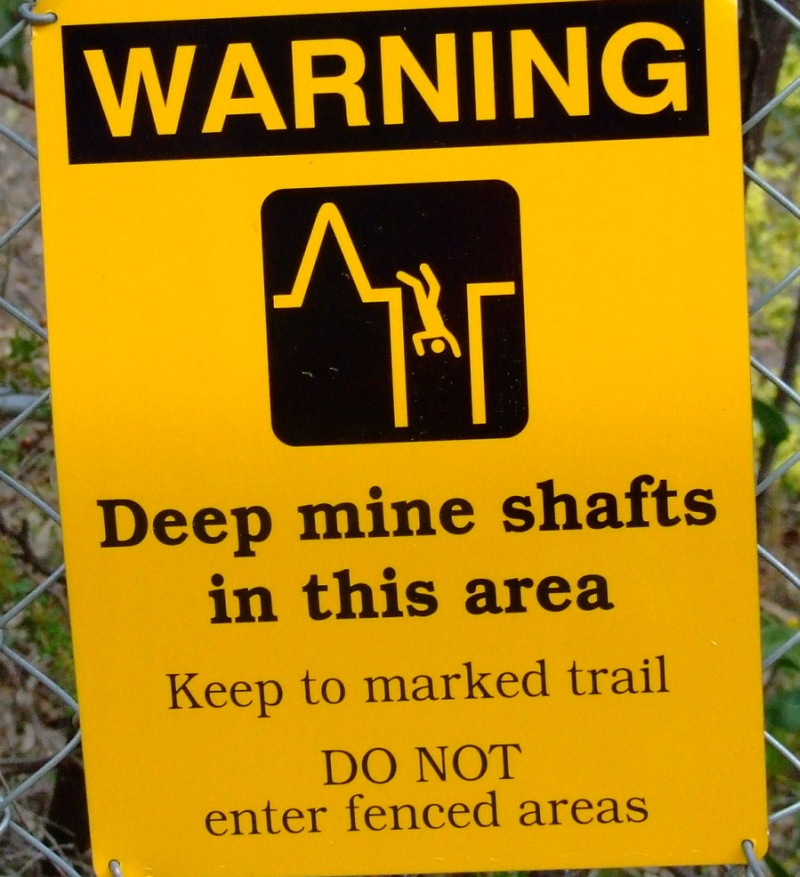
Many more are locked and barred, in the interests of public safety. And rightly so --
Parents do have to keep an eye on their more adventurous kids, but the whole area is very well signed,
and dangerous areas are also comprehensively fenced.
Mines apart, there are other reasons to hike Jupiter Creek. If you can get there in September or October, the woods
are a mass of wild flowers, and flowering trees give the valley the "enchanted forest" appeal...


Jupiter Creek in October: "enchanted forest." A sheer joy for photographers.


And in springtime, before the heat of summer has dried the woods right out, don't forget to look down. At your feet
is a pixie garden, or fairy garden, of mosses, ferns, fragile beauty on the scale of the very small.


No Australian wood would be complete without its termite nests. Big ones can be 3-4 feet tall.
Jupiter Creek: keep a look out for bearded dragons!
Driving the Adelaide Hills and Fleurieu Peninsula today, it's impossible to imagine this tranquil landscape reverberating to the clamor, hustle, noise and widescale destruction of a gold rush ... but it happened. Gold was discovered in the early 1860s (some years after the Victorian gold rush), and ambitious men flooded into the area.

The first thing they did was clearcut the hills. Evey tree for about fifty miles was logged, and many regions still show the consequences of erosion. Copper-rich rocks burst right through the scrappy topsoil ... only the forests were holding the ground in place.

Jupiter Creek is a wonderful hike on a warm day. It's three kilometers of secondary-growth woodland, seasonally carpeted with wild flowers. Do it in September or October, if you can; but wait a few days after there's been significant rain, because low-lying parts of the valley flood. Alternatively, be ready to go paddling!

Here's what the Batunga County website says of Jupiter Creek:

The second major diggings in the Echunga area opened up after payable alluvial gold was discovered at Jupiter Creek by Henry Sanders and Thomas Plane in 1868. By September 1868 there were about 1,200 people living at the new diggings and tents and huts were scattered throughout the scrub. A township was established with general stores, butchers and refreshment booths. 

By the end of 1868 though, the alluvial deposits were almost exhausted and the population dwindled to several hundred. During 1869 reef mining was introduced and some small mining companies were established but all had gone into liquidation by 1871. 

...read the full story right here: http://www.battunga.org.au/jupiter-creek-and-chapel-hill/ ... or better yet, hike Jupiter Creek and read the information boards. There's a lot to read, and all of it fascinating.

We've been there four or five times, and on a couple of visits Dave went prepared with flashlights and so forth. We went right through the hill, the New Phoenix mine, by torchlight ... three meters underground it's gloriously cool on a hot day. I could see taking shelter from a heatwave there, with a picic basket! In fact, the only thing the Jupiter Creek site does not have is (!) a bathroom. So visitors are always just passing through, on their way to a cafe for coffee after a great little hike. Fortunately there's a fantastic cafe in Mylor, nearby ... we'll take you there soon.


Thursday, April 21, 2016

Destination: Monarto! Lions, giraffes, meerkats ... on safari in South Aus

Lions of the Monarto pride...
A safari in your own backyard! Monarto "Zoo" is certainly not a zoo in any conventional sense of the word. The "enclosures are vast paddocks and the animals enjoy almost as much freedom as they would in the wild, as well as being utterly safe from poachers. Monarto has a small but growing pride of lions, and a couple of young females were close enough to the viewing platform for us to get some terrific pictures.

In fact, there are so many wonderful pictures to share on this post, most of them have been pasted in as thumbnails. If you'd like to see them at full size, just click them: everything is big; we just can't display them large, or this page would be ten yards long!


...at this point the lions meandered away to a patch of shade beyond the reach of cameras, so it was time to hop back on the bus, for a ride to the next part of the park:
Ride the bus around Monarto: very handy ... you buy one ticket at the gate, and then hop on and off the bus at whim,
stopping as long as you like at any one "paddock."
Hunting dogs: faaar away, at the extreme range of telephoto, and on the other side of a fence. Dang. But at least we got pictures... everyone else had left the area! Patience is rewarded.
Monarto's paddocks are connected by walkways to the main bus routes. There's a lot of walking involved, even if you do
hop on the bus the whole time. Wear your walking shoes ... and a hat. Shade is rare, and it can be very hot indeed.

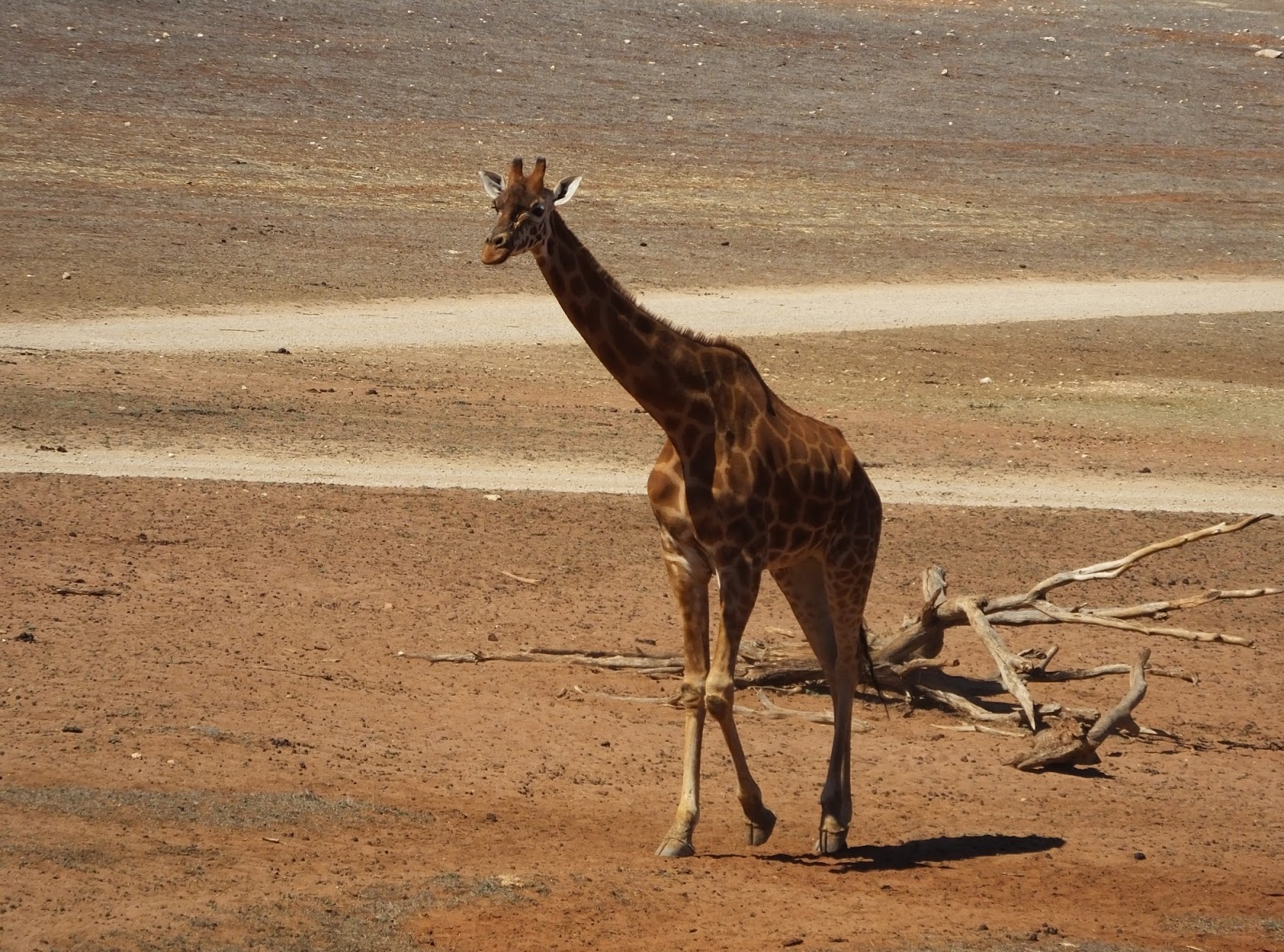
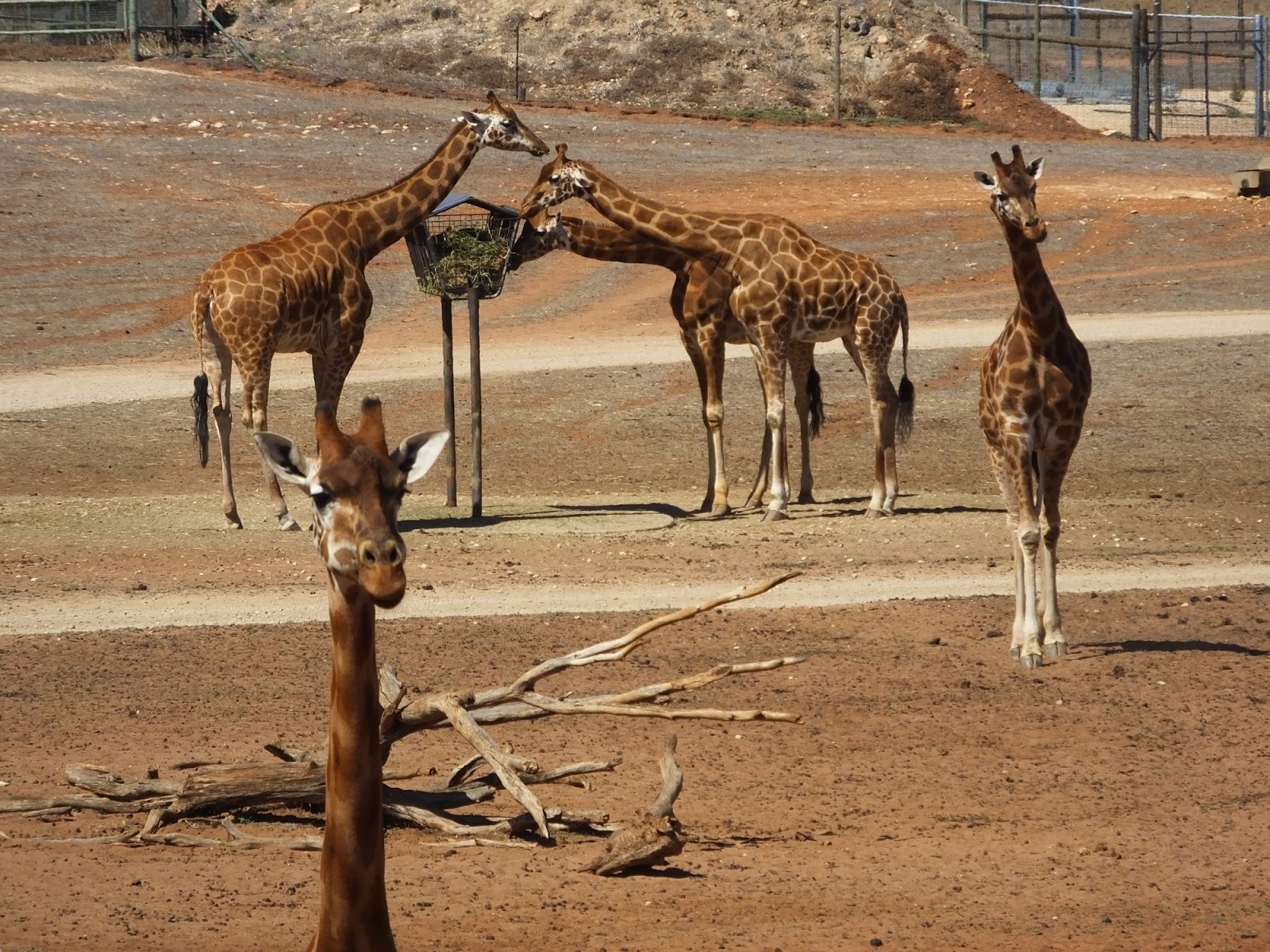
Giraffes at Luncheon...
Giraffes are so pretty! They have the longest eyelashes you ever saw, and the daintiest legs. They're also very, very
shy, and skittish. We happened along just at feeding time, and the busload of eager photographers were
exhorted to be quiet and not make a big fuss.

Giraffes ... with femme fatal eyelashes, and eyeliner. They really are beautiful.


Below: other views in the Giraffe Paddock, which those tall folks share with some bovines whose horns are ... epic. These are eland and kudu. In fact, the bus will swing you through several vast "enclosures" where you really could believe you were on the savannah ... except for the fact those are eucalypts in the background rather than the acacias one would actually expect in Africa...


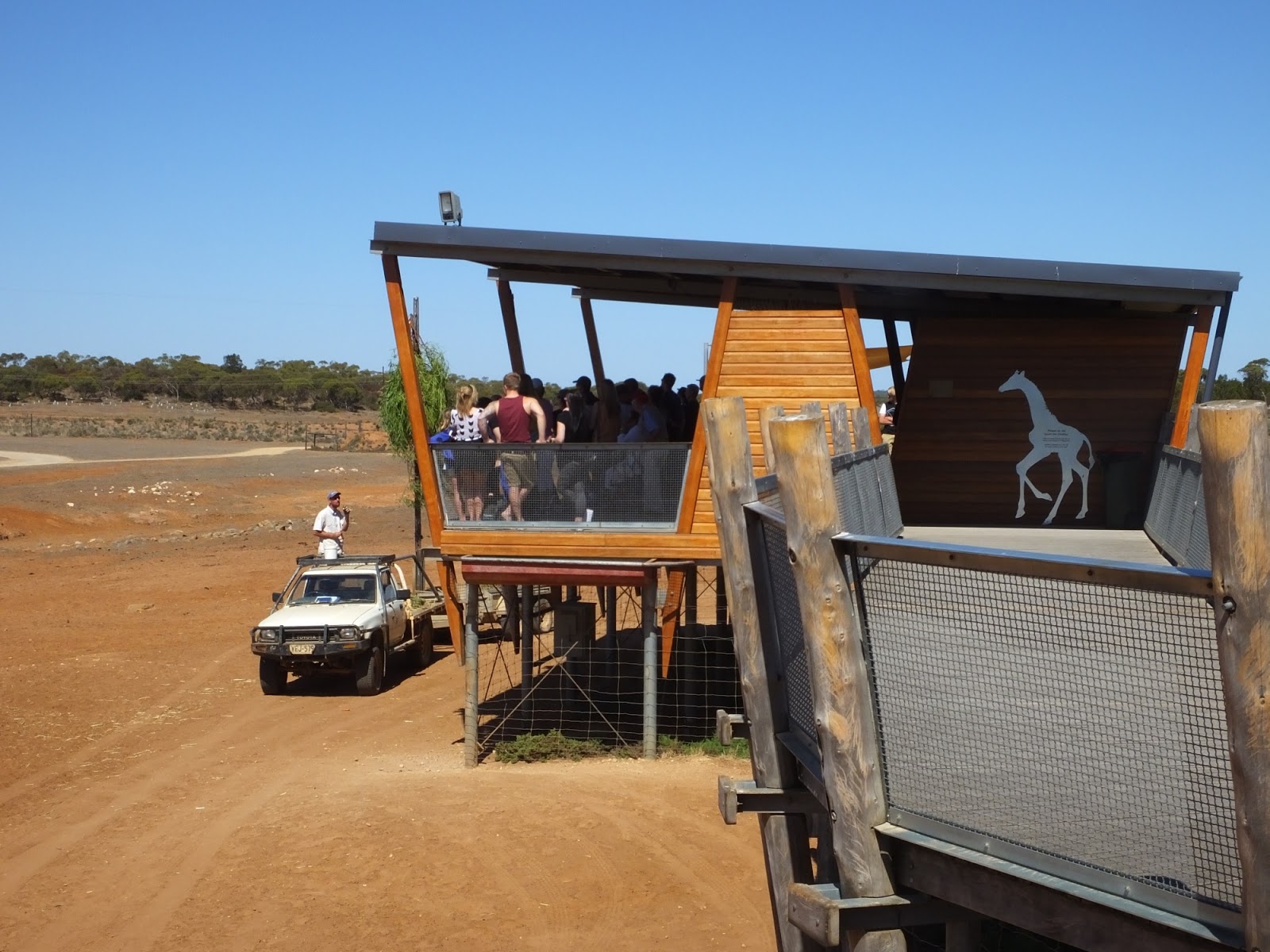
The giraffe viewing platform is -- well, elevated, which affords a great view of Monarto's giraffes. The animals come
right up to the platform, where the specialist will occasionally hand-feed a carrot while giving a layman's lecture on
giraffes in general and these gorgeous animals in particular. 


Now, we'll take the bus through herds of bovines ... the herbivores are separated out from the lions by tall fences and distance, naturally. Stock feed comes in by truck for the animals, since -- as you can see at a glance -- they "eat out" the graze immediately. (What are the lions eating? One almost hesitates to ask, but we could make a few rather unfortunate guesses. What else can you do?)

And in the background, behind the bus, yes: an ostrich, not an emu!


Meerkats on sentry duty ... and at play!
There's only one word you could use to sum up meerkats...
The word is, CUTE!


Back on the road, leaving Monarto and headed for Murray Bridge, Langhorne, Milang, Goolwa ...
Monarto ... covered in one post! The hardest thing about this one was figuring out which pictures not to upload, because there were so many fantastic ones, and then figuring out how to display more than fifty images on one post with some skerrick of coherence! Reiterating -- ALL the images were uploaded at large size, and to see them, just click on the thumbnails.

The park is enormously rewarding though the ticket price is quite high, as you'd expect. Be prepared to do a LOT of walking; do put on your walking shoes and take a hat because you'll be in the sun a great deal and it's almost certainly going to be hot, unless you brave the mud in the middle of winter!

Here's what Wikipedia says of Monarto:

Monarto Zoological Park (also known as the Monarto Zoo) is a 1,500-hectare (3,700-acre) open range zoo located in South Australia administered by the Royal Zoological Society of South  Australia Incorporated (trading as Zoos SA). It is located at Monarto approximately 70 kilometres (43 mi)  from Adelaide's centre.

The zoo features several unique attractions, including a drive-through cheetah habitat, a southern 
white rhinoceros habitat, and Australia's largest giraffe herd. It is also home to South Australia's largest  revegetation project. As of 2015 Monarto zoo has achieved one of the most successful giraffe breeding  programs in Oceania.

We enjoyed it enormously -- would recommend it, and will doubtlessly do it again one day. But as the shadows were lengthening it was time for us to hit the road again. We had a long way to go, and another day in which to do it!

Next time: Murray Bridge, Langhorne and Milang in the morning light...
Related Posts Plugin for WordPress, Blogger...