Showing posts with label restaurant. Show all posts

Thursday, April 4, 2019

Halls Gap ... "Under the Mountain," literally!


The Village of Halls Gap lies in a pass in the Grampians, quite literally "under the mountain," and often invisible in the morning mist. Here, we see it from Boroka Lookout, in late March 2019...


Driving into the village, you're tremendously aware of being in a mountain pass. The walls rise like ramparts, almost at the bottom of people's back gardens...


From the street -- where you'll find everything you could possibly need, from a newsagent to a supermarket, by way of cafes and ice cream parlor -- just look up under those vines:


The view from the roadside is spectacular!


There's more to Halls Gap than, at first, you assume. Quiet streets angle back from Grampians Road, which is the main thoroughfare, into woodland that's abundant in wildlife, right in the village.
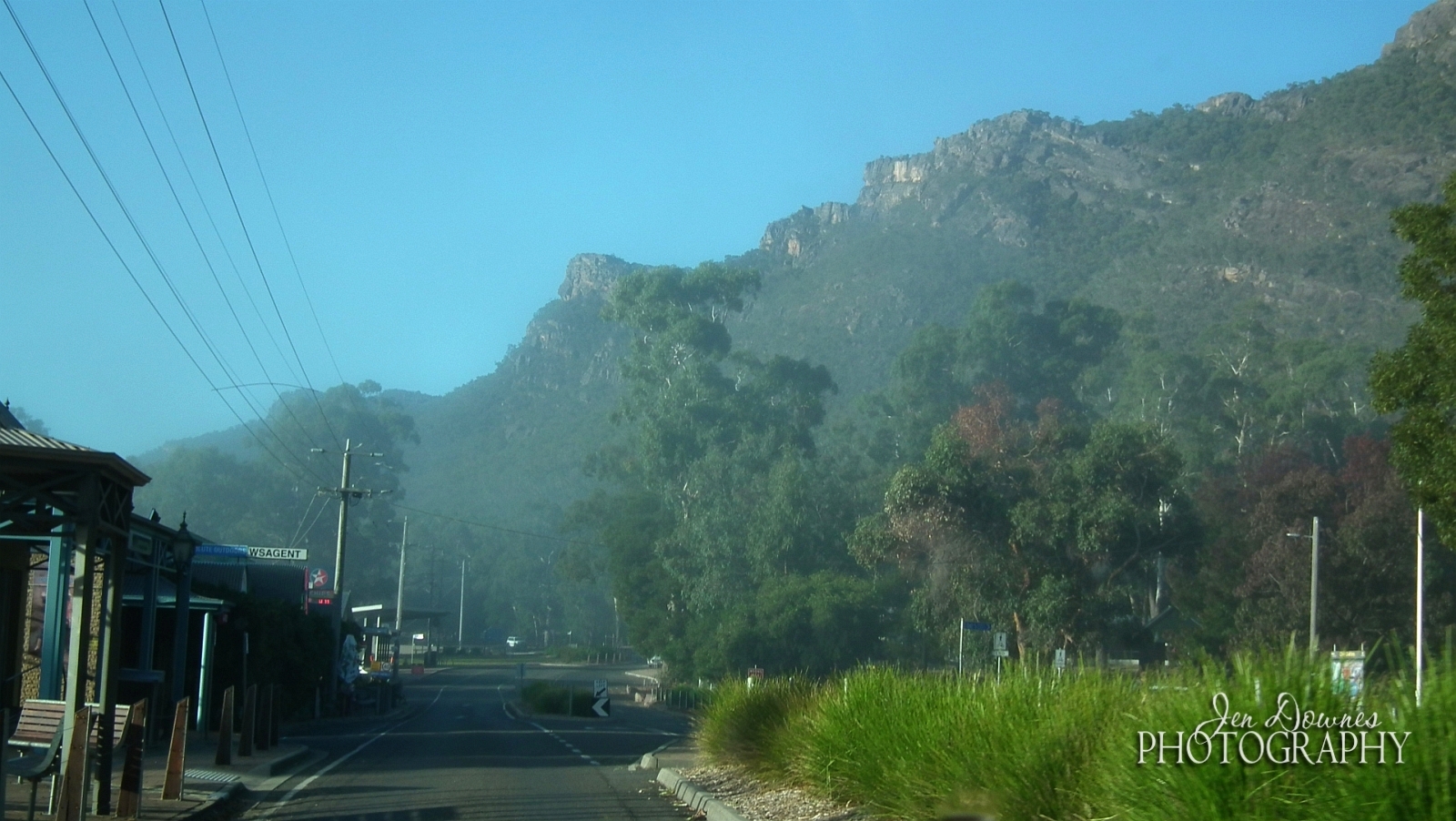

On misty mornings (of which there will be many), Halls Gap drowses like Brigadoon until the sun burns off the fog ...


Up on Boroka Lookout here, it's already sunny (if not quite warm! You're 616 meters high), but if you look off to the left side, you can see the mist that still fills the gap --


...yes, Halls Gap is down there. Did I say Brigadoon?! Magical.

Having arrived in the village, you have about a hundred choices of where to stay. This was ours:


We booked a log cabin at the aptly named Halls Gap Log Cabins ... one word: fantastic! First, there are kangaroos, wallabies, emus, bilbies, in your backyard --


And perhaps just as importantly, the cabins are absolutely luxurious, with a combustion heater, TV/DVD, full size fridge, queen size bed, spa bath ... the works:


You might be in a village in the mountains, but you're certainly not roughing it! (Though there's plenty of that, if you want it: caravanning and camping are very well catered to.)

Now, what about dining out? We did brunch at Harvest, and dinner at Darcy's, which is the restaurant attached to the Comfort Inn...


The food is excellent, and in the evening, long after the sun is down, the grounds around Darcy's, back and front of the Comfort Inn, are thronged with grazing wallabies and kangaroos:


Check out the roo getting a drink at the fountain there! Too cute.

The cultural heart of Halls Gap is Brambuk, where 'Grampians' becomes 'Gariwerd,' and the country's original owners' voice speaks clearly:


We need to set aside a whole afternoon for Brambuk. There's far too much to see and do than you could manage by strolling through. Also, a very nice cafe and the usual gift shop.

On the way out of town...


Lake Bellfield is a man-made lake ... the reservoir serving Halls Gap and the surrounding area. Completed in 1966, just 18 years before Grampians National Park was declared. In Victoria, swimming and sailing are allowed on many of the reservoirs ... wish we did this in SA!

Leaving Halls Gap --


-- the only question is, where are we going today? Hang a right, head for the national park, and keep the cameras handy, because every time you come around a bend in the road, something spectacular happens...


Tuesday, June 30, 2015

Dawn at Milang, Breakfast at Clayton Bay, English 'dry stone walls' at Callington, then -- lions and zebras and bison, oh my!

Dawn rises over the wetlands at Milang, South Australia...
...and when we're staying over in Milang the day begins with a photo assignment --
You get up when the first flush of dawn colors appears in the sky, and...
...walk right across the empty main road outside the Milang Lakes Motel...
...and there's the wetlands, and the rising sun.
On this trip the sky was clear, which doesn't make for a brilliant dawn, so --
-- the challenge was to "get creative" with the shots, and... 
...make the most of everything we had to work with. In the end we wound up with so many good shots --
-- the hardest thing was paring them down to a scant handful to upload here!
The weltlands were alive with birds that morning -- 
-- and not one of them came close enough to photograph! So we said  "nuts" and --
-- went right back over to Clayton Bay, pronto, on another assignment: breakfast!
Sails at Clayton Bay is a marvelous cafe-restaurant, and
-- they're situated right there on the waterfront...
--serving the best breakfast you can imagine. This hit the spot. Yum!
Clayton Bay: "you are here." You can actually read the history on the board here, seen at full size.
Looks like a great day to be out on the water. Boats were launching e very few minutes --
-- from the boatramp right alongside the jetty, while...
...pelicans fished for their own breakfast along the riverbank.
But we have a date with lions and zebras, so it's already time to get out of Dodge!
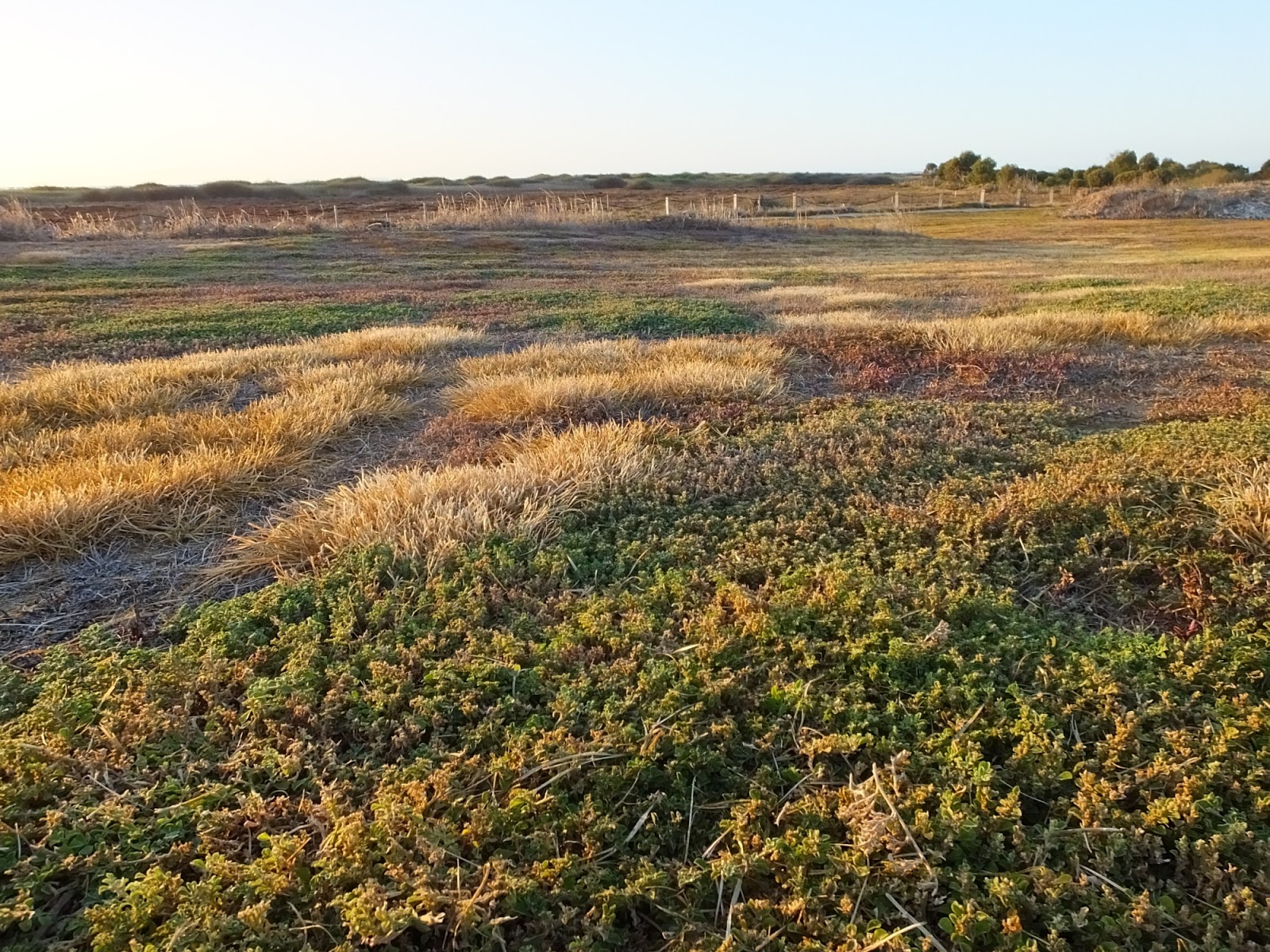
Halfway over to Monarto, we stopped on Callington Road to capture a photogenic landscape. 
The Callington area is a picturebook landscape. It must be lovely in winter, when it's green. Must come back!
Callington would very likely have been settled originally by folks from the UK, because --
check out their "dry stone walls." These are commonplace ... in England's north-east, that is.
Art meets nature. Eucalypt trees shed their bank, not their leaves --
and when they do, sometimes you get an effect like abstract painting. Pretty!
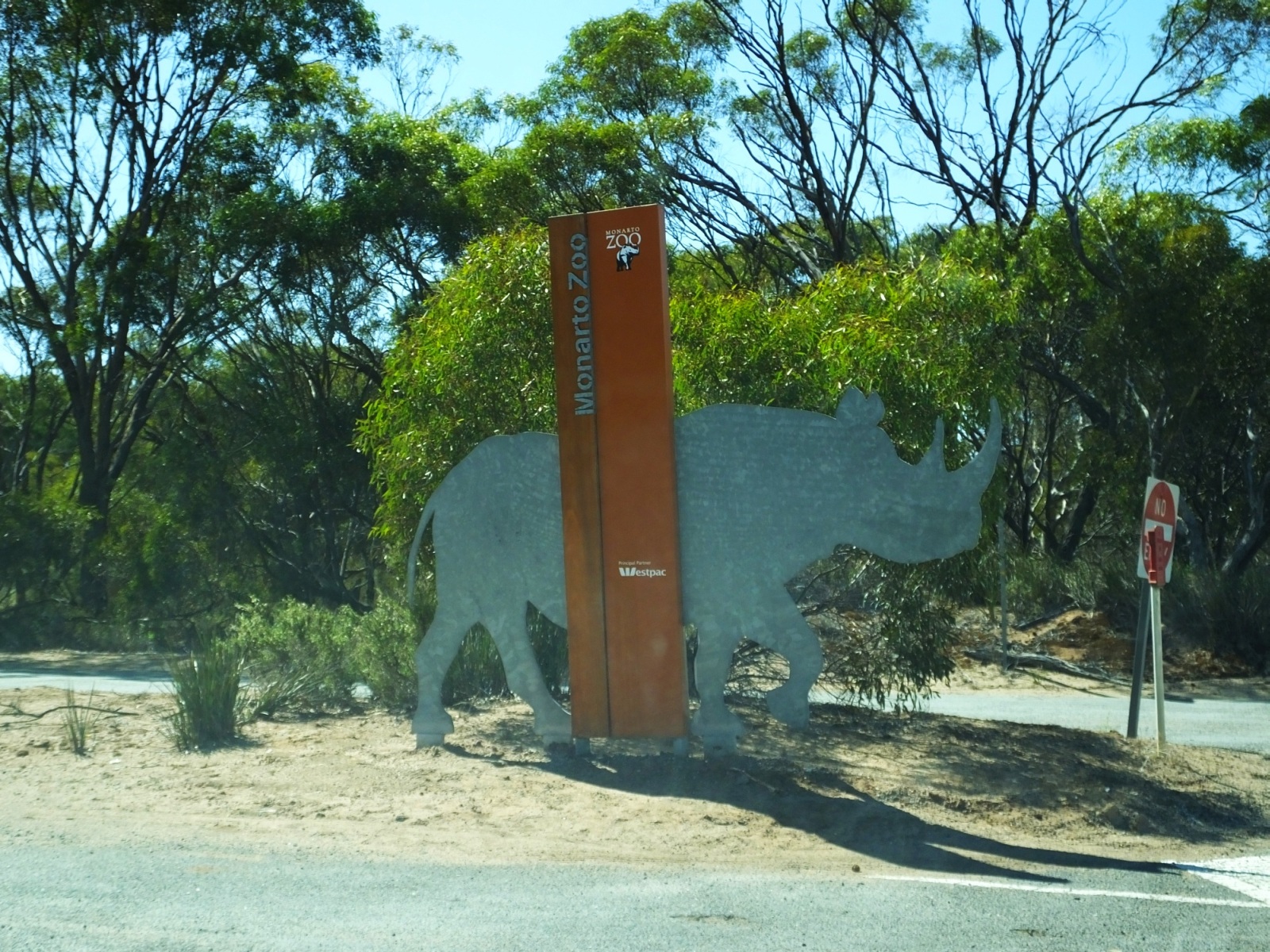
At last -- welcome to Monaro Wildlife Park ... not a 'zoo' as we generally think of them.
Drive right up to the gates and inside. Buy tickets at the kiosk to the right there.
It's actually quite expensive; but then again, it must cost a fortune to run this place. So...
Walking up from the huge "parking pasture" you enter the wildlife park itself right here.
The way in is through the shop. Yep, we'll be stopping there on the way out.
Check out the giraffe skeleton. Wow. There's also a lot more skeletons: next post!
Monarto is home not only to African wildlife, but to endangered species from other continents.
These are Przewalski's horses, and here's what Wikipedia says of them: "Dzungarian horse is a rare and
endangered subspecies of wild horse native to the steppes of central Asia."
And the good news is, they thrive -- and breed! -- at Monarto in South Australia.
Likewise, America bison thrive here -- though they must wonder what happened to the grass.
Seriously, Monarto is a series of massive paddocks in which grazing animals run almost totally free,
and the fact is, they graze simply out the land. Now...
... if Monarto were four times the size, staff could afford to move the stock from one paddock to another,
rotating herds around so the recently-grazed paddock could lie fallow and recover. Alas,
 there's no such luxury, so these animals may run free, but they're fed fro the back of a truck.
The zebras thrive at Monarto, and breed readily in this environment.
And Monarto contributes to the world-wide breeding program which is right now
rescuing the white rhino, bringing it back from the thin edge of extinction.
Grant's gazelles run free ... and the dead giveaway that these are in Australia is
hopping along the fence at upper left! Yep -- kangaroos also abound in these paddocks.
Can't see him clearly? Check out this picture at large size!
Then, it's on to the lion enclosure...
Lions! This is what you wanted to see, right?
We have some great pictures, which we'll be uploading in the next post!

It's been ten years since we last visited Monarto, and we were surprised by the changes. It's much more developed than we recall, and one of the best changes is that they now have a very excellent shuttle bus "service" running round and around inside the park. The bus stops at various points adjacent to the viewing areas for giraffes or lions or whatever, and you can get on and off said bus as often as you like, so you could spend as long as you wanted in a certain place.

The park is 2,500 acres, which sounds like a lot, but if Monarto has one problem it's that it's about 25% as big as it really needed to be, if it were going to remain lush and green. True, it'll be greener in wintertime, but herds of antelope, bison and so on will graze out the paddocks. In the end, the stock will be "fed off the back of a truck." (Which, yes, is also true of local domestic animals -- cattle, sheep, horses, alpacas. Even camels, if you're sharp-eyed.)

It's very good to see species which are endangered in other lands doing well here. One can hope that in future the conditions may be right for returning the great-great-grand-offspring of these creatures to the wild.

The sun shone, we hopped off the bus here and there, and we came home with so many terrific photos, it was a major challenge to pare them down to a comparative handful for blogging. We're also going to cover Monarto in at least two posts, so --

Next time: lions, giraffes and a lot more!
Related Posts Plugin for WordPress, Blogger...