Sunday, June 5, 2016

Brighton and Seacliff: cafe culture and yacht races on the metropolitan beaches

Brighton, South Australia -- a fantastic place to spend a sunny winter's afternoon in June...
Brighton is all about cafe culture: gourmet coffee and good food, along Jetty Road --
Jetty Road, Brighton, in the summer ... cafes galore to your left as you head to the beach. See that arch up ahead...?
The Arch of Remembrance is the "gateway" to Brighton's jetty --
The Brighton Jetty is easy to pick out of any assortment of jetty pictures...
...it's the structures ON the Jetty that make it so easy to recognize. Like --
The Aeolian Harp, or "wind harp." Stand under it, when the breeze blows!
The view south from the Brighton Jetty looking towards Seacliff. We're going there next.
Time to head back for dry land ... and coffee!
Cafe culture on a lavish scale. It's your choice of a dozen different places to eat. Then --
Turn left from the end of Jetty Road ... Seacliff is a whole whopping kilometer away!
Seacliff is all about holiday homes and mansions, right above the rocky reef.
Seacliff on a summer day -- not much difference visually between summer and a sunny day in winter.
The big difference is the temperature. Winter's not really cold, but summer...!
A close-up look at the reef itself. Paradise for beachcombers. See the houses at left, there? Well --
--here they are in summer. Could be the Mediterranean, or the Adriatic. 
Low tide on Seacliff Reef ... tidepools full of tiny crabs.
Seacliff Beach looking back towards Brighton, where we were ten minutes ago.
On top of the cliff at Seacliff is a lovely little gazebo with incomparable views, like...
The view from the top, at Seacliff, over the Surf Life Saving Club roof, to those mansions. And --
The famous "Seacliff ZigZag," which is a zig-zag ramp connecting clifftop with beach and yacht club.
Seacliff Reef is a rich fishing ground for local professional fishermen and amateurs alike...
Also the perfect place to put a 'trailer sailer' in the water for an afternoon. Or --
Water skiing? Sure. You also see paragliders, kite flyers, beach cricket -- the works.But if you want boat races...
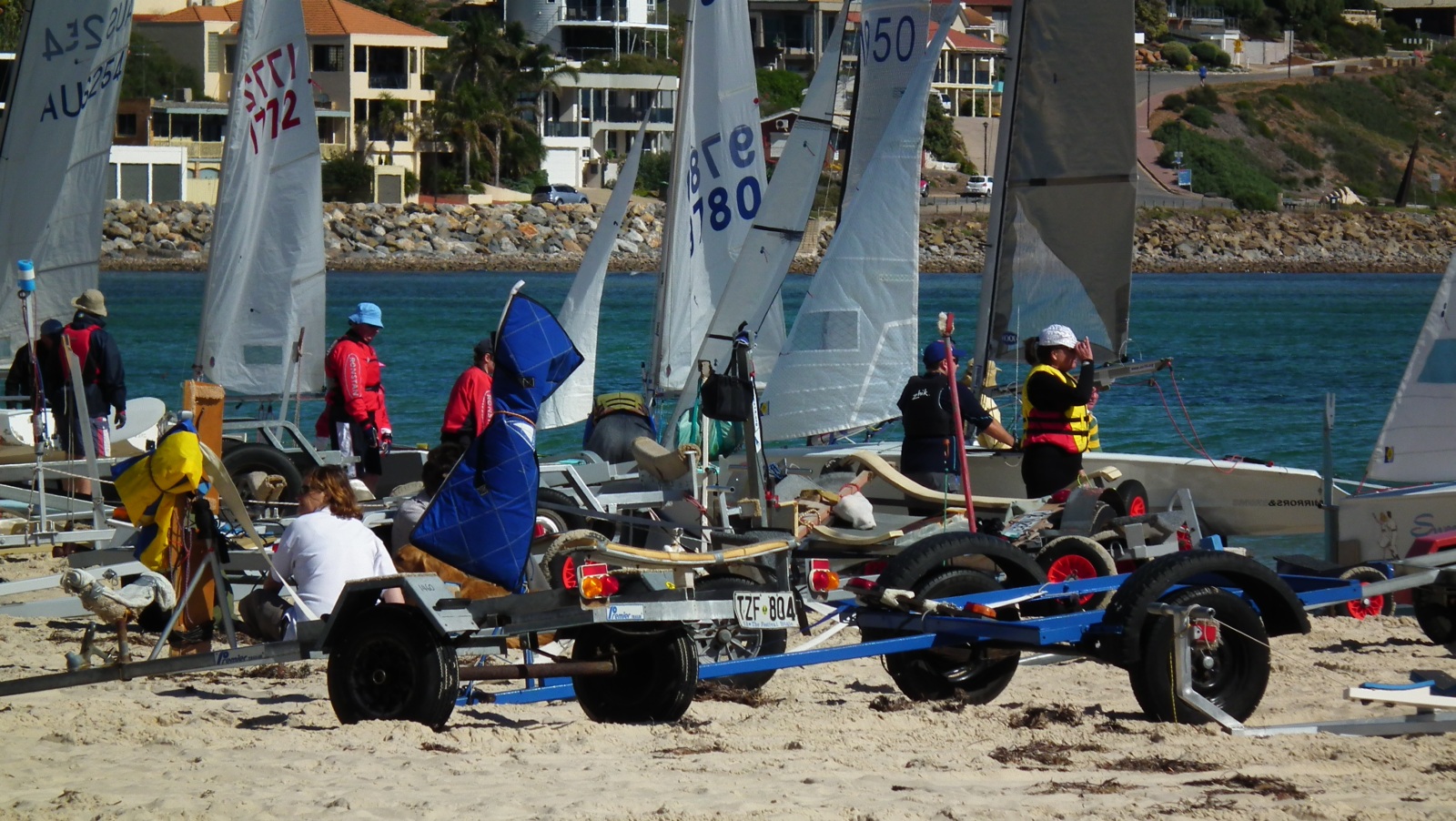
Setting up for a boat race at Seacliff Yacht Club.
The tractor helps launch boats at Seacliff.
Yachts ranked on the Seacliff beach, ready to race...


And they're racing! 

Anyone for coffee? A kilometer north, and you'e back to Brighton's world of cafes on Jetty Road!
Down under, June is the middle of winter, and when the sun shines, people make the most of it. Winter has to happen sooner or later ... it's gotta rain, or we'd be living in the Sahara, and we don't want that! In fact, we're always glad to see a drop of rain, especially on the rare occasions when it comes in summer; but in winter, when we see a blue sky day, we grab the opportunity.

Today we headed 'in' rather than 'out' ... of town, that is. Usually, we make tracks for the hills and valleys -- national parks and woodland. But with this sky, we headed into the southern suburbs with the idea of doing a "beach crawl," from Brighton to Seacliff, then on to Marino and Hallett Cove. Here's the first of two posts: Brighton and Seacliff. Well go to Marino and Hallett Cove in the next post.

Most of Adelaide, South Australia, has access to what we call the 'metropolitan beaches.' It's just what it sounds like: the beach where the city ends on the west side. Look at a Google satellite image of the Adelaide area --

We're one loooong coastline, with the city sprawling north-to-south. The beaches begin at Port Adelaide in the north and extend ... forever. We've covered Glenelg on the blog here in another post, and in the next post we'll take you to Marino and Hallett Cove ... we've already shared Christie's Beach here and here, as well as Silver Sands. One day soon, we'll "join the dots" and post a major "beach crawl" from top to bottom. For now --

June 4, 2016, was warm, sunny ... perfect. We were actually on our way out to hit the shops, and couldn't resist "going to the beach" first. The beauty of it is, the whole thing could be done within fifteen or twenty minutes of home; and nowhere was more than a few kilometers from anywhere else. You don't have to drive for hours to get there, or back.

Brighton, South Australia, is all about cafe culture; and it has one of the world's most recognizable jetties. You could pick it out of any Police lineup because of the structures on it; for example, the "Aeolian Harp," or wind harp. When the breeze blows through, it makes odd music ... and the breeze is always blowing. Scuba diving, boat handling, swimming and surf life saving are all taught and practiced off this beach ... and even in the height of summer, you won't see it crowded.

From the cafes of Jetty Road, Brighton, turn south along the Esplanade ... in a kilometer you're on Seacliff Beach, which revolves around the Yacht Club and Surf Life Saving Club. It's even quieter than Brighton, unless there's a boat race in progress -- at low tide it's gorgeous with fields of tidepools filled with tiny crabs and microscopic fish.

From the top of the cliff, the views are superb. You can drive up from the Seacliff Hotel corner, or else flex your muscles and walk up the famous Seacliff Zigzag -- the zip-zag ramp which connects clifftop with beach and yacht club.

From here we headed south to Marino and Hallett Cove.   

Thursday, May 5, 2016

Jupiter Creek -- a glimpse of Gold Rush South Australia

Jupiter Creek -- the iconic Beatrice chimney, built in 1869
Welcome to Jupiter Creek -- the trail head. Note the green: we usually do this hike in spring!
The Millennium Possum -- aka the Mitsubishi Express -- waits in the car park...
...and who else should be there in the parking lot, but a bearded dragon! These guys are about a foot long, and shy.
Take a moment before you hit the trail, and read the  information board. The gold rush came to South Australia in the 1850s and 1860s, and the drama was on, full-throttle. Today, it's a haunted, haunting place...
The Jupiter Creek hike is fairly easy, and takes you through up to three kilometers (about two miles) of woodland...

...and the trail takes you to sites like the New Phoenix shaft, which you can actually get into. And we did...
A flash shot of the deep interior of the New Phoenix mine shaft. It's cool, deep underground...
Follow the New Phoenix shaft right through the hill, and you come to a barred gate in a shaft of daylight. 
From the top of the New Phoenix shaft, a ladder goes down into the pit -- and you can climb down:
Dave, being Dave, did just that. Kinda "Spellunking" at Jupiter Creek. 
The trail linking the many mines is well marked. Just follow the arrows, and --
You find yourself approaching many different operations, such as the Beatrice Mine, whose chimney is...
well, it's like something out of The Lord of the Rings. Echoes of dwarven folktales, and Moria... 
The Beatrice Chimney, 1869, Jupiter Creek, South Australia.
Take a minute to read a little of the history of the Beatrice Mine
This was, as Aussies say, "hard yakka." Hard work -- and not for humans alone:
One can only speculate about the life of a draught horse in this era, anywhere in the world.
Nor was Jupiter Creek the only goldfield in the state. Driving the Adelaide Hills and Fleurieu Peninsula
today, it's hard to imagine such tranquil landscapes resounding the the ruckus of a gold rush. Dang.
Many claims were made and worked at Jupiter Creek. You get actually get into one or two, but --
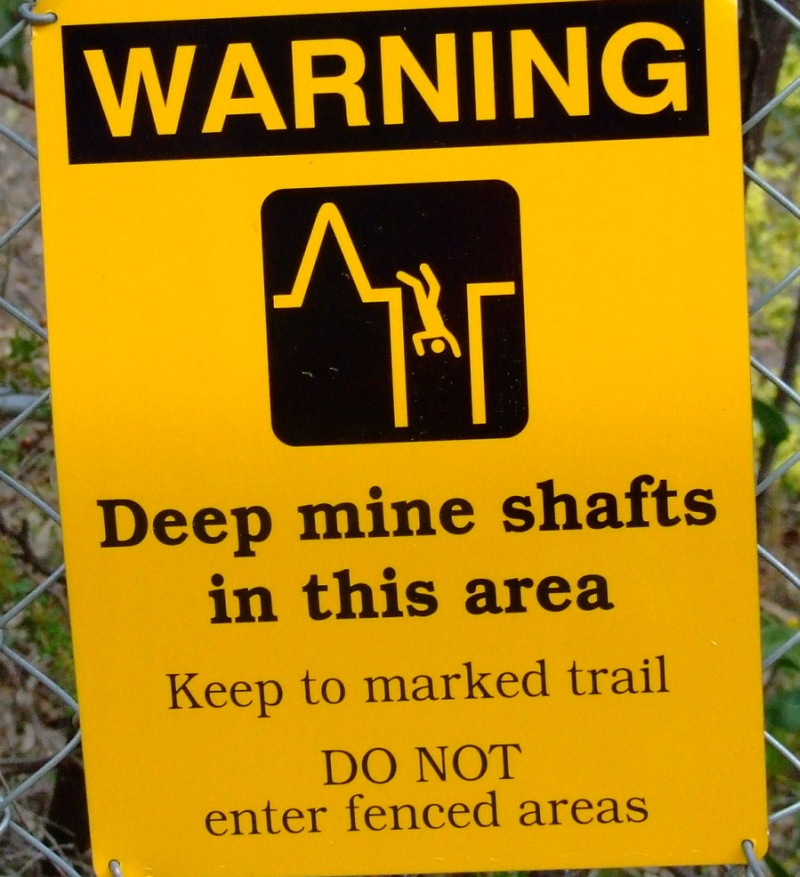
Many more are locked and barred, in the interests of public safety. And rightly so --
Parents do have to keep an eye on their more adventurous kids, but the whole area is very well signed,
and dangerous areas are also comprehensively fenced.
Mines apart, there are other reasons to hike Jupiter Creek. If you can get there in September or October, the woods
are a mass of wild flowers, and flowering trees give the valley the "enchanted forest" appeal...


Jupiter Creek in October: "enchanted forest." A sheer joy for photographers.


And in springtime, before the heat of summer has dried the woods right out, don't forget to look down. At your feet
is a pixie garden, or fairy garden, of mosses, ferns, fragile beauty on the scale of the very small.


No Australian wood would be complete without its termite nests. Big ones can be 3-4 feet tall.
Jupiter Creek: keep a look out for bearded dragons!
Driving the Adelaide Hills and Fleurieu Peninsula today, it's impossible to imagine this tranquil landscape reverberating to the clamor, hustle, noise and widescale destruction of a gold rush ... but it happened. Gold was discovered in the early 1860s (some years after the Victorian gold rush), and ambitious men flooded into the area.

The first thing they did was clearcut the hills. Evey tree for about fifty miles was logged, and many regions still show the consequences of erosion. Copper-rich rocks burst right through the scrappy topsoil ... only the forests were holding the ground in place.

Jupiter Creek is a wonderful hike on a warm day. It's three kilometers of secondary-growth woodland, seasonally carpeted with wild flowers. Do it in September or October, if you can; but wait a few days after there's been significant rain, because low-lying parts of the valley flood. Alternatively, be ready to go paddling!

Here's what the Batunga County website says of Jupiter Creek:

The second major diggings in the Echunga area opened up after payable alluvial gold was discovered at Jupiter Creek by Henry Sanders and Thomas Plane in 1868. By September 1868 there were about 1,200 people living at the new diggings and tents and huts were scattered throughout the scrub. A township was established with general stores, butchers and refreshment booths. 

By the end of 1868 though, the alluvial deposits were almost exhausted and the population dwindled to several hundred. During 1869 reef mining was introduced and some small mining companies were established but all had gone into liquidation by 1871. 

...read the full story right here: http://www.battunga.org.au/jupiter-creek-and-chapel-hill/ ... or better yet, hike Jupiter Creek and read the information boards. There's a lot to read, and all of it fascinating.

We've been there four or five times, and on a couple of visits Dave went prepared with flashlights and so forth. We went right through the hill, the New Phoenix mine, by torchlight ... three meters underground it's gloriously cool on a hot day. I could see taking shelter from a heatwave there, with a picic basket! In fact, the only thing the Jupiter Creek site does not have is (!) a bathroom. So visitors are always just passing through, on their way to a cafe for coffee after a great little hike. Fortunately there's a fantastic cafe in Mylor, nearby ... we'll take you there soon.


Tuesday, May 3, 2016

Silver Sands on a perfect winter's day ... downunder


Silver Sands, on the Gulf St. Vincent coastline, South Australia ... on an absolutely perfect winter's day. Yes, I know, we're spoiled rotten as far as our climate goes. The weather was changing, there was a wind swinging around into the south, and by the next day skies were overcast, there was a little bit of drizzle around the southern hills. In winter, you have to pick your day, but if you can pick it just right, there are some days that are just magical. This was one of them.

We were parked on the beach, fossicking for shells, watching the sky, and I'll always have some fond memories of that afternoon!


Related Posts Plugin for WordPress, Blogger...